

ATTRACTING PATIENTS AND BUILDING VISIBILITY
Building a private practice brand patients instantly trust
In private practice, how you brand your practice helps patients decide whether they feel confident choosing you, often before they even get in touch. Neon Rocks’ Founder and Managing Director, Natasha Hassani, shows you how to build a brand that communicates trust, reflects your expertise and helps patients feel reassured from the very first impression.
 |
Natasha Hassani, Managing Director, Neon Rocks |

Launching in private care is not just a clinical step, it’s a reputational one. Most clinicians who step into private practice are highly skilled, experienced and respected in their field, but branding can feel unfamiliar and risky. There’s a quiet concern about appearing too commercial, too promotional or simply getting it wrong. Medicine is about care and outcomes, where patient treatment and patient safety come first, so for many it can feel uncomfortable to even think about creating a brand.
Branding in healthcare is not about aesthetics. It’s about trust architecture: creating clarity, coherence and credibility across every place a patient can encounter you. And today, that begins long before they walk into your clinic.
How patient discovery has fundamentally changed
Ten years ago, private care was driven primarily by referrals, hospital networks and professional relationships. Those things still matter, but now every patient also researches you. They will:
- Search your name on Google
- Read your reviews
- Visit your website, mostly on their phone
- Check your qualifications
- Search for you on ChatGPT
- Compare you with competitors
Patients form impressions in seconds. AI-driven search has accelerated this shift: platforms summarise clinicians’ expertise based on clarity, consistency and authority signals, which is why clear positioning and consistent messaging are essential from the start.
Branding foundations: Where to start
When clinicians launch, they often focus on visuals first. Logos. Colours. Fonts. Those matter, but they’re not the foundation. The foundation is positioning.
1. Define who you’re for
Private care grows faster and patient bookings increase when patients feel directly addressed. Trying to appeal to everyone often results in resonating with no one clearly.
Perhaps you are known for complex revision cases. Perhaps you specialise in women’s health, high-performance athletes, or longer consultations with a focus on continuity. Specificity builds authority. It doesn’t limit you, it clarifies you.
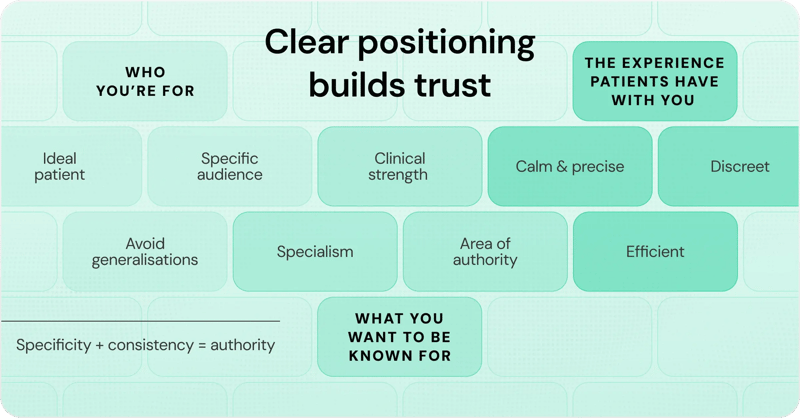
2. Define what you want to be known for
This is different from listing everything you can do. Consider what you want your name associated with in five years’ time.
AI search, media coverage and referral networks all strengthen around clear specialisation. If you don’t define your area of strength deliberately and accurately, it will be defined passively, often in a diluted way.
3. Define the experience patients have with you
Brand isn’t only what you say. It’s what patients feel.
Calm. Precision. Warmth. Discretion. Efficiency. Depth. These qualities should shape your messaging, site structure and communication style. They should be visible in patient scheduling and booking confirmations, consultation flow and follow-up communication. When experience and positioning align, credibility strengthens.
Standing out in a crowded local market
Many healthcare brands sound interchangeable. ‘Patient-centred.’ ‘Personalised.’ ‘State-of-the-art.’ These phrases don’t differentiate you - what differentiates you is the clarity you provide about your service.
What type of patient do you most want to attract?
What type of case do you most want to be known for?
What clinical strength genuinely sets you apart?
Where these three intersect, your positioning sits. You don’t need to artificially narrow your clinical offering, but you should lead with a defined area of strength. Premium brands feel focused. Overly broad brands feel indistinct.
Building brand clarity
We often see practices launch with a beautifully designed logo and a vague website. Eighteen months later, they’re reworking everything because patients are unclear about what they actually specialise in. A clear structure at the beginning prevents that.
A simple structure that works well for most practices includes:
- A clear homepage explaining who you are, where you practise and what you specialise in
- A detailed clinician profile outlining qualifications, experience and areas of expertise
- Dedicated pages for each core treatment or condition you manage
- Supporting educational content that answers common patient questions
- Clear contact and booking information
Within these pages, positioning is critical. If it’s vague, you’re harder to understand and less likely to be surfaced. For example, compare these two ways of describing a practice:
Vague positioning:
“Experienced consultant offering a range of treatments for various conditions.”
Clear positioning:
“Consultant spinal surgeon specialising in complex revision surgery and failed back surgery cases.”
Or in dermatology:
Vague positioning:
“Advanced skin clinic offering a wide range of treatments.”
Clear positioning:
“Dermatology clinic focused on evidence-led acne treatment for adults and long-term skin health.”
These latter examples are far easier for both patients and search systems to understand, strengthening trust and visibility at the same time.
Polish is tempting, but structure is what performs
At launch, many clinicians understandably focus on what feels visible and creative. Logo design. Social media aesthetics. Whether to invest in an agency immediately. But the elements that drive long-term growth are often quieter and more structural. Instead, focus on the elements of branding that clinicians classically overlook:
- Clear, niche positioning
- Brand structure across your website and patient touchpoints
- Optimising your Google Business Profile
- Review strategy: building review collection into your operational process early ensures authority grows steadily rather than reactively
- Internal consistency: making sure your messaging is the same across your site, Google profile, patient booking system, patient emails
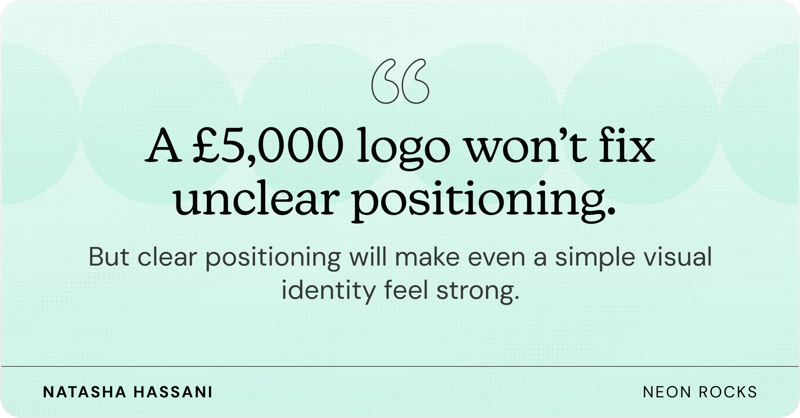
If time and budget are limited, prioritise structured website copy, professional photography and a well-optimised Google Business Profile. These are credibility multipliers. A £5,000 logo won’t fix unclear positioning. But clear positioning will make even a simple visual identity feel strong.
Visual identity still plays an important role
While structure and positioning form the foundation of your brand, visual identity reinforces professionalism and trust. Healthcare branding works best when calm, clear and uncluttered. A restricted colour palette, often neutral or muted tones, helps create a reassuring, cohesive impression across your website, signage and patient communications.
Typography should prioritise readability: clean sans-serif fonts work well on screens and mobile devices, with strong contrast for accessibility.
When it comes to photography, use authentic images of clinicians, the team and clinic space. Portraits are most effective when they’re natural, professional, with neutral backgrounds, soft lighting and relaxed posture, reflecting the environment patients will actually encounter in-person.
Branding throughout the patient journey
Brand is not confined to your website. It lives in the details of the patient journey.
It shows up in the ease of booking and the tone of confirmation emails. The clarity of pre-appointment instructions and the structure of the consultation. The follow-up communication.
Patients interpret organisation as competence.
Small refinements can create disproportionate impact: structured email templates, clear pre-appointment guidance, easy-to-follow steps in patient scheduling, consistent tone across all written communication, thoughtful follow-up messaging and a calm, cohesive clinic environment.
None of these require excessive budget, just intention.
AI, search and modern patient discovery
Search behaviour has evolved rapidly. Today, patients ask more direct questions such as ‘Who is the best spinal surgeon near me?’ or ‘Who specialises in revision rhinoplasty?’
If your expertise is not clearly stated and repeated across digital platforms, those systems struggle to understand what you’re known for.
To perform well in this environment, your specialisms should be clearly stated and consistently described. Reviews should be genuine and steadily accumulated. Contact details and professional information should be identical everywhere they appear.
Educational content should reinforce your positioning. Condition pages should clearly explain what you specialise in and how you approach care. This helps patients quickly understand whether you’re the right specialist for them, while also helping search systems interpret your expertise more confidently.
AI visibility strengthens when your brand is coherent. If your website, Google Profile and messaging describe you differently, authority weakens. Consistency reinforces discoverability.
Content, reputation and authority
In private care, reputation compounds. Reviews build trust through lived experience, so embedding review collection into your processes early helps authority grow steadily rather than reactively.
Educational content strengthens this further. Clear condition pages, treatment explanations and FAQs help patients understand your expertise before they meet you, while thoughtful commentary reinforces credibility over time.
A strong signal of brand clarity is when patients begin describing your practice using the same language you use about yourself. They arrive understanding what you specialise in. Digitally, this often appears as clearer search behaviour, stronger engagement with key treatment pages, more searches for your practice name and enquiries tied to your expertise. Tools like Google Analytics, Google Search Console and your Google Business Profile can help track these signals.
Above all, clarity matters. Each piece of content should have a clear purpose. Reputation builds gradually, but with a strong foundation it becomes one of the most powerful drivers of long-term growth.
Your branding checklist for the first three months in private practice:
First 30 days
- Define your positioning clearly
- Identify your ideal patient profile
- Clarify core services and expertise
- Develop structured brand messaging
- Secure professional photography
- Optimise your Google Business Profile
- Establish a review collection process
By 90 days
- Publish educational content
- Strengthen brand structure across your patient touchpoints
- Ensure full messaging consistency
- Refine patient journey touchpoints
- Build early authority signals
- Monitor visibility and adjust

Natasha Hassani is the Founder and Managing Director of Neon Rocks, a specialist healthcare brand and digital strategy agency.
Neon Rocks works exclusively with private clinics, surgeons and medical businesses across the UK and internationally, supporting them with website design, brand development, SEO optimisation and AI-led search visibility.
Natasha specialises in positioning, structured messaging and modern patient discovery. Her work focuses on building coherent, reputation-led healthcare brands that are clearly defined, professionally represented and discoverable in an increasingly AI-powered search landscape.

.svg)