

ATTRACTING PATIENTS AND BUILDING VISIBILITY
Marketing for the AI era
AI is reshaping how patients discover, compare and choose healthcare providers, creating new opportunities for clinics that are clear and easy to find online. Here, Oliver Capel looks at how to build a marketing approach that works in this new landscape.
 |
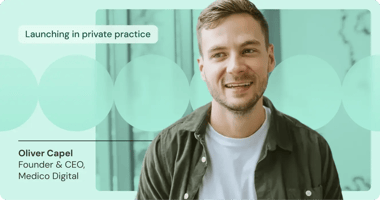
Oliver Capel, Managing Director, Medico Digital |
When clinicians move into private care, marketing is often one of the biggest unknowns of practice management. Most people know they need a website. Usually, the default is ‘I need to do SEO’ or post on Instagram or - deep breath - TikTok. But few understand how patients actually find healthcare providers today or where to focus their attention when time and budget are limited.
The reality is that marketing private healthcare has changed dramatically over the past few years. Clinics that once relied almost entirely on referrals for new patients are now operating in a digital-first world, where patients research, compare and often make decisions before they even speak to a clinician.
The good news? This shift has levelled the playing field. You no longer need to be a large, established clinic to attract patients, but you do need to build visibility and trust in all the right places.
Here’s how to build a marketing strategy that works in today’s AI-driven, high-choice healthcare landscape.
Understanding how patients find care today
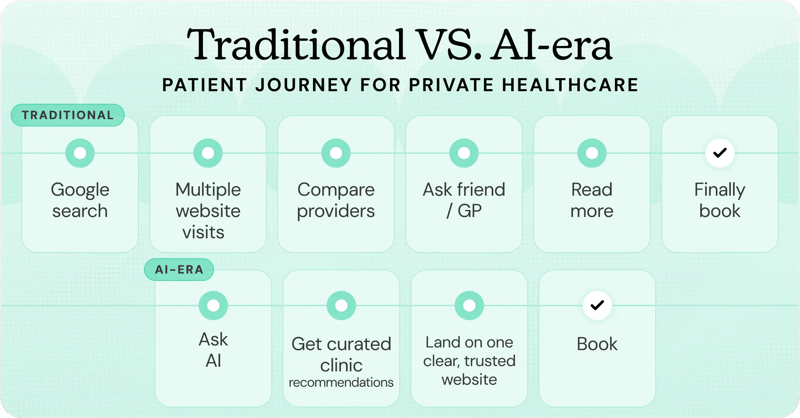
Until recently, most patients followed a familiar journey: a Google search, a few website visits, maybe a recommendation from a friend or GP and then, finally, requesting a patient booking. That journey is now much shorter.
These days, patients don’t search the internet as much as they ask it. Patients are putting their burning healthcare queries to AI tools, alongside consulting Google’s own AI-driven search results, and instead of clicking through dozens of websites they’re receiving curated recommendations for clinics, specialists and services.
In practice, this means many patients now arrive on a clinic’s website already informed and ready to book. AI has effectively done the research for them.
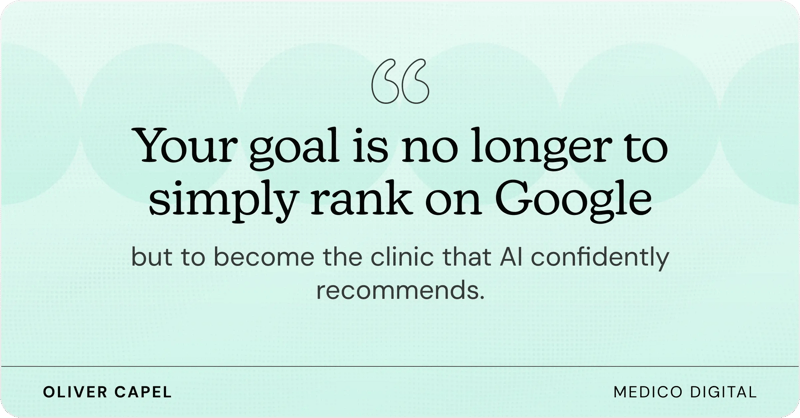
For new practices this is a huge opportunity, but only if your clinic is visible, clear and credible online. Your goal is no longer to simply rank on Google, but to become the clinic that AI confidently recommends when patients ask ‘Where can I find a good cardiologist near me?’ or ‘What’s the best IVF clinic in central London?’
AI tools, just like the patients using them, favour clinics that explain their services well, present information transparently and demonstrate those all-important real-world trust signals such as reviews, locations and clear patient journeys.
In other words, we’ve moved beyond the gimmicks of marketing yesteryear, like keyword stuffing or constant social posting. Now it’s all about building a digital presence that genuinely helps patients make confident decisions. This means your marketing needs to work on two levels:
For machines: clear, structured, factual information
For humans: reassurance, expertise, credibility and a sense that ‘this clinician is right for me’
If you get both right, you give yourself the best possible chance of being surfaced and chosen.
The trust factor matters more than ever in healthcare
Healthcare is rarely an impulse purchase. Patients are making important decisions that rely heavily on who they can trust with their health, and they’re likely spending a significant amount of money on that decision. So their trust in your practice to deliver total patient safety needs to feel strong and innate.
Once that due diligence with AI has been carried out, the decision to make a purchase can be made in just a few seconds online, so first impressions count. When someone lands on your site, they’re subconsciously asking themselves:
- Do I understand what this clinic offers?
- Do they feel professional and credible?
- Can I see real people who have had good experiences here?
- Is it easy to take the next step?
If the answer to any of those is unclear, patients will simply move on. This is why modern healthcare marketing needs to focus less on promotion and more on that clarity, reassurance and experience. Essentially, your job isn’t to persuade. It’s to remove doubt.
So let’s build that trust.
Your website: the centre of your marketing strategy
While lots of things have changed about digital marketing, this remains the same: you need a good website. For a new private practice, this will be your main growth engine.
It should clearly explain:
- Who you help
- What services you offer
- What the patient journey looks like
- What happens next
- How to book or enquire easily
The most effective clinic websites are simple, transparent and written in plain English. They answer the same questions patients ask every day in-clinic and guide them towards taking action.
Rather than trying to impress with technical language, focus on helping patients feel informed and comfortable. If a patient can understand your services, process and expectations at first glance, you’re doing it right.
Becoming visible where most patients actually search
One of the fastest and most overlooked wins for new clinics is setting up and optimising a Google Business Profile – and best of all, it’s free to set up.
This places your practice on Google Maps, helps local patients find you when searching nearby, and builds immediate credibility, especially when paired with patient reviews.
For many clinics, this becomes one of the easiest ways to generate visibility in search results.
Alongside this, encouraging patients to leave reviews early on is a powerful signal of trust. In healthcare, social proof really matters. Seeing real experiences from real patients is often the difference between someone booking or continuing their search.
Great care naturally leads to great feedback, but making it easy to leave a review is what ensures it actually happens.
Marketing towards AI-driven search
In the old days of marketing, traditional SEO used to revolve around publishing lots of keyword-driven blog content. That approach is becoming far less effective, particularly for new, smaller clinics competing with major healthcare brands.
Instead, what works today is clarity and usefulness. That might sound a little vague, so let’s break it down. Essentially AI tools and modern search engines prioritise clinics that can clearly explain:
• Their services and treatments
• Who they’re for
• What outcomes patients can expect
• Location and accessibility
• Appointment scheduling processes
• Pricing or cost guidance where possible
The more directly and transparently you answer patient questions, the more likely your clinic is to surface in both traditional search results and AI recommendations.
If you can explain something clearly in a consultation, you should explain it clearly on your website. That content does far more for visibility than dozens of generic blog posts will.
And of course, all those good reviews we talked about, from the likes of Google, Doctify and TopDoctors, will all help the credibility of your site, helping you show up in recommendations.
The quickest way to attract new patients
Once your foundations are in place - a clear website, strong local visibility, visible reviews and a simple online patient booking system - the fastest way to generate early enquiries is usually highly targeted paid search advertising.
This means appearing at the exact moment someone is actively searching for your service in your area.
The keyword here is targeted. Unlike a lot of other marketing channels, search reaches people with real intent. Someone searching for “private physiotherapist near me” or “same-day GP appointment” is actively seeking care - not browsing, not researching for later. They’re ready to book.
Paid ads only work when they send patients to a clear, specific service page. If your messaging is vague or your online booking process is clunky, advertising will be less effective and could end up costing you a lot of money.
If you’re running ads in your first year, keep it simple:
- Focus on one or two core services, ideally higher-value treatments or services with strong demand
- Target patients searching for those services locally
- Send them to a page that clearly explains what you offer and how to book
- Start with a modest budget and monitor enquiries closely
- Do your competitor research. If you’re competing for search phrases targeted by major providers, you may want to consider other more niche areas of your practice
In the early weeks, your goal isn’t scale, it’s learning. Pay attention to which searches lead to patient bookings, which pages perform best and where people drop off. This quickly shows you what patients actually respond to, allowing you to refine both your messaging and spend.
Paid search isn’t essential for every practice. But when your basics are strong, it can be the quickest way to build early momentum.
How to know what’s actually working
One of the biggest mistakes new clinics make is investing time or money into marketing without any way of knowing whether it’s working.
You don’t need complex reports or even marketing software, but you do need a simple way to answer a few basic questions:
-
Where did this enquiry come from?
-
Did that enquiry turn into a patient booking?
-
Which services are generating the most interest?
This can be as straightforward as tracking enquiry sources in your booking system or using basic website and ad tracking tools.
The goal here isn’t perfection, it’s more about awareness at this stage. If you know that most of your bookings are coming from Google searches and reviews, you can invest more there. If social media ads are generating clicks but not appointments, you can adjust or pause them quickly.
Marketing becomes far less overwhelming when you can see, even roughly, what’s driving real patients into clinic.
First 30 days in clinic: Clarity and credibility
- Make sure your website clearly explains your services, who they’re for, and what patients can expect
- Make sure your booking or enquiry flow is easy and responsive
- Set up and optimise your Google Business Profile so patients searching locally can find you easily
- Implement basic tracking so you can see where enquiries are coming from
- Put a simple process in place for requesting reviews from satisfied patients
Your first 90 days: Drive patient enquiries
- Choose one or two core services with clear demand and direct advertising traffic to well-written service pages
- Monitor closely which searches lead to real bookings
- Use what you learn to refine your messaging
- Continue building reviews steadily and strengthening your local presence
Oliver Capel is the founder and CEO of Medico Digital, a specialist healthcare digital and medical communications agency. With hands-on experience with patients and healthcare professionals, he has supported public and private healthcare providers across multiple markets to deliver on their digital objectives.
His ethos aligns mission-led growth with a strong focus on balance, culture and outcomes, helping healthcare organisations build the digital capability needed to reach, support and connect with the people they serve.
.svg)