

ATTRACTING PATIENTS AND BUILDING VISIBILITY
Attracting patients in private practice (and keeping them)
Attracting patients in private practice starts with making it easy for people to find you, understand what you offer and feel confident taking the next step. Medico Digital’s Oliver Capel explores the practical changes that help turn online interest into new patient bookings, and first appointments into lasting patient relationships.
 |
Oliver Capel, Managing Director, Medico Digital |
When clinicians move into private care, most assume that if they deliver a top-notch service, patients will naturally follow. The truth can be a little different.
Patients today have more choice than ever, shorter attention spans and far less patience for confusion. They don’t carefully browse multiple practice sites. They search, skim and decide in just a few minutes.
As such, the practices that thrive aren’t always the biggest or the most established. They’re the ones that feel clear, credible and easy to engage with from the very first interaction. Here, we’re going to help you understand just how patients actually choose care today and what you can do, practically, to both attract them and keep them coming back.
How patients really find private practices now
Most patient journeys now start online, even when a referral is involved. A patient might Google or ChatGPT a symptom, search for a specialist near them, read a handful of reviews, glance at one or two practice websites and make a decision almost immediately.
What these prospective patients are really looking for isn’t just excellence. It’s reassurance. They want to feel confident that you understand their specific concern and that with your practice, they’re in experienced, trustworthy hands.
They need a clear picture of what will happen next: how the process works, what their care journey will look like and what they can expect from you at each stage. And crucially, they want to know that your patient booking system is straightforward. During an anxious time, this simplicity is crucial.
This is why clarity is so important: if any of those pieces feel unclear, patients will move on to the next option.
The moments that decide whether a patient books
So let’s dive into this in a bit more detail. There are a few points in the journey where practices either win or lose patients.
The first is the moment someone lands on your website or practice profile. They should understand who you help and what to do next within seconds. If they have to hunt for answers… well, they won’t.
The next is around your costs and process. Practices often avoid talking about pricing because they worry about putting people off. It’s a valid concern, but in reality, vagueness does more damage than transparency. Patients don’t need exact figures for everything, but they do need expectations. Even simple ranges can help build trust.
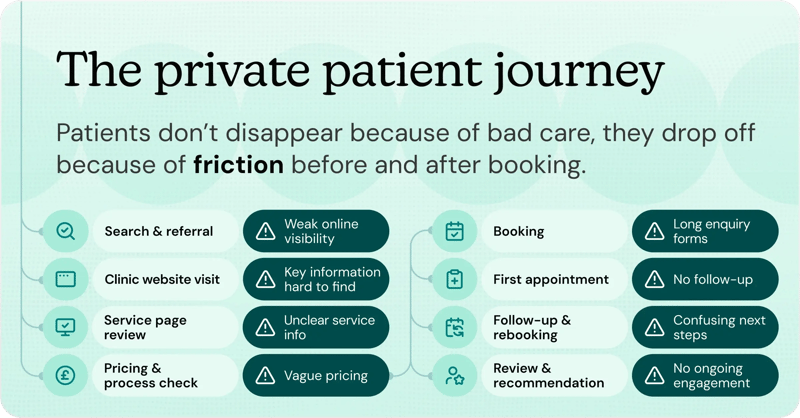
The third is the booking experience itself. The easier it feels, the more patients convert. Long forms, slow replies or being forced to phone during working hours will lose you patient bookings every day.
It’s a pattern you’ll recognise from your own life. If booking a long-haul flight feels complicated or unclear, you choose another airline. You don’t spend your hard-earned money on something that feels risky. Now add the anxiety of a health concern and that hesitation multiplies.
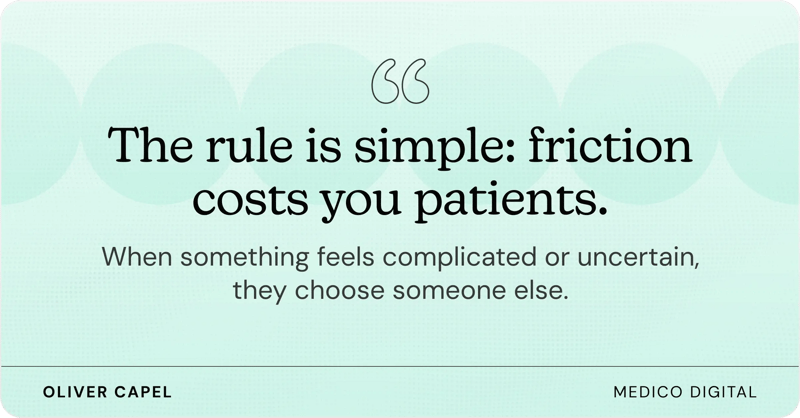
The rule is simple: friction costs you patients. When something feels complicated or uncertain, they choose someone else.
How to grow your patient list without a marketing budget
Good news if you’re not a natural blogger or somebody who loves getting behind the camera: for new or small practices, success rarely comes from constant content creation.
For you, it’s all about getting the fundamentals down:
A strong local presence, particularly on Google Maps is one of the biggest drivers of new patients.
Clear service pages that explain exactly what you do, who it’s for and the cost expectations will convert far better than generic clinic descriptions.
And real patient reviews that showcase successful patient management and treatment build trust faster than any piece of marketing copy ever will.
Too many practices spend far too much time agonising over a blog schedule and scrutinising their social media without fixing the basics that actually turn interest into patient bookings. Search engines are trying to match specific patient intent, not just reward lots of content.
When someone searches for ‘private cardiologist in London to help with chest pain’ or ‘cost of an ADHD assessment near me’, search tools will favour these clear service pages that directly explain your service, because they will answer the practical questions around cost, process and suitability that patients are searching for. If you get that right, you’re already ahead of most practices.
The most valuable marketing improvement you can make
If you only focus on one thing when launching, make it this: create clear, patient-focused service pages.
Each key service page you offer should answer certain questions for patients:
- What’s the issue you’re treating?
- Who is this service for?
- What happens during treatment?
- Who delivers it?
- What outcomes can I expect?
- How much will this cost me?
- How can I book?
- Have other patients been through this treatment? What did they think?
These pages remove uncertainty, which is the biggest barrier to booking. Practices that do this well often outperform those who spend far more on advertising.
How AI search is reshaping patient behaviour
We know patients don’t look for answers the way they used to. The days of typing a couple of keywords into Google are gone; the prominence of generative AI platforms like ChatGPT and Gemini means people now ask complete, specific questions instead.
Rather than searching ‘private cardiologist London’, they’ll ask: ‘Can a private cardiologist in London see me quickly for chest pain, and how much will it cost?’
These longer, more detailed searches are what marketers call ‘long-tail’ queries or ‘prompts’, but in simple terms, they’re just real, specific questions that reveal much clearer intent. Patients are looking for something specific and they expect results tailored to that need.
In many cases, AI has already summarised their options before they even click on a website.
All of this means your content will need a more modern approach too. In the old days of search, keyword stuffing was the norm. Today, what performs best is copy that is genuinely helpful, specific and easy to understand.
Simple service explanations, FAQs, reviews, location signals and real practice information (your services, clinician profiles, your address, patient reviews) are what AI surfaces and trusts.
And remember that search is now more conversational. Practices that reflect real patient language are the ones most likely to be found and chosen.
What makes patients return (and recommend you to others)
Nothing in life is certain except death, taxes and people’s need for healthcare at multiple points in their lives.
It’s rare, impossible even, that a patient would ever be ‘one and done’. Beyond chronic conditions, life stages alone create the repeated need for medical intervention. Across a woman’s lifespan, for example, care may be needed for contraception, fertility, maternity and menopause, alongside possible treatment for ongoing conditions such as endometriosis.
Attracting patients is only half the picture. The most successful practices put as much focus and attention on what happens after the first appointment.
So what does it mean to keep patients in your care? It’s not about constantly reminding your patients that you’re there or sending them promotional emails. It’s all about the experience they have while they’re with you.
The trifecta of patient loyalty is simple: trust. They feel looked after, they feel well informed and they feel remembered.
That usually comes down to small but powerful fundamentals:
- Clear pre-appointment communication that reduces anxiety
- Simple follow-ups that explain next steps
- Rebooking and further patient scheduling that feel effortless
- Occasional, relevant check-ins that feel considered and relevant rather than promotional
When the experience is strong, trust follows naturally. And when trust builds, recommendations follow.
The patient metrics that really matter for small practices
If you’re new to this, it’s all too easy to get distracted by website traffic or social engagement, but these metrics won’t give you the kind of detail you’re craving. If you really want a clear picture of how your practice is performing, focus on metrics that reflect real patient behaviour:
- How many enquiries turn into booked appointments?
- How many first visits turn into returning patients?
- How quickly do you respond to enquiries?
- Are you getting a steady growth of good reviews?
- What’s the cost of each new patient?
These are the numbers that show whether the foundations we’ve been laying throughout this article are working.
Building a practice people choose
Good news: starting a private practice today doesn’t mean becoming a marketing expert overnight.
You don’t need a viral Instagram account or a solid ‘three blogs a week’ writing schedule. You just need to be easy to find, clear about what you do and transparent about what it costs.
Most new practices don’t struggle because they lack clever marketing, but because there’s friction in the process: unclear information, tricky booking, patchy follow-up or a patient portal that’s difficult to use. Once you fix that friction, growth becomes much less mysterious.
If you focus on being genuinely helpful and easy to access from day one, patient growth tends to follow naturally. Build the foundations well, improve little by little, and you’ll create a practice that people not only find, but return to and tell their friends about.
Your first 30 days in private practice: Build the foundations
- Make sure each main service you offer has a clear page explaining what it is, who it’s for, what happens and how to book
- Set up and verify your Google Business Profile so local patients can find you easily
- Create a simple system for asking happy patients for reviews
- Ensure enquiries are responded to quickly and clearly
Your first 90 days: Remove friction and build trust
- Refine your service pages based on real patient questions
- Simplify patient scheduling wherever possible
- Add FAQs based on what patients commonly ask
- Introduce simple follow-up messages after appointments
- Start tracking where enquiries come from and how many convert

Oliver Capel is the founder and CEO of Medico Digital, a specialist healthcare digital and medical communications agency. With hands-on experience with patients and healthcare professionals, he has supported public and private healthcare providers across multiple markets to deliver on their digital objectives.
Oliver's ethos aligns mission-led growth with a strong focus on balance, culture and outcomes, helping healthcare organisations build the digital capability needed to reach, support and connect with the people they serve.
.svg)