
Welcome to your CQC toolkit: Registration, inspections and ongoing success
Wherever you are in your CQC journey, this toolkit is here to help you feel informed, prepared and more confident about what comes next.
 |
Pascale Day |

Welcome to your CQC toolkit, we’re so glad you’re here! Chances are you’re taking an exciting step forward with your private practice, and this guide is here to help you do that with confidence.
If you’re setting up, running or growing a healthcare service in England, understanding the Care Quality Commission, better known as the CQC, is an essential part of the journey.
It’s also one of the areas many healthcare professionals tell us they find most overwhelming.
We get it – there’s so much to take in. It’s highly likely you’ll be juggling trying to understand the registration requirements for your service, preparing for your registration interview and getting your head around the ever-changing CQC inspection framework, all at once. And that’s all while trying to launch a business. No easy feat by anyone’s standards.
Even the most experienced providers can feel unsure about where to start, what matters most and how to stay compliant without getting buried in paperwork. And that’s exactly why we created this CQC hub.
At Semble, we work with thousands of healthcare professionals, many of whom are heading towards their CQC registration or even their inspection. And what we see consistently is the uncertainty that surrounds CQC at every stage.
So we wanted to bring together clear, practical guidance for healthcare providers who want to feel more confident about CQC.
With the help of two bona fide CQC experts, Jonathan Andrews of Govanta Compliance and Gabi Ashton of Let’s Make Lemonade, think of this as your toolkit, helping you understand the full picture, from registration and inspection preparation through to audits, governance, feedback, technology and ongoing compliance.
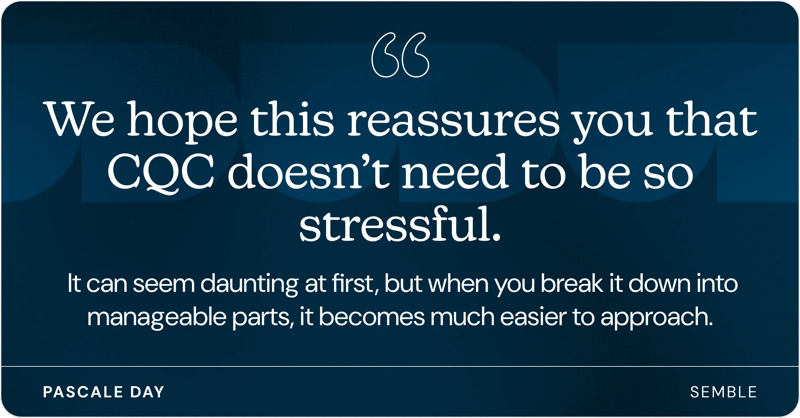
Most importantly, we hope it reassures you that CQC doesn’t need to be stressful. It can certainly seem daunting at first, but when you break it down into manageable parts, it becomes much easier to approach with confidence.
This toolkit covers the full CQC journey
This hub has been created to support providers at every stage of that journey.
If you’re right at the beginning, we cover the basics, starting with what the CQC actually is, which services it regulates and whether your service needs to be registered. If you’re preparing an application, we explain the CQC registration requirements, including the roles you need to define, the feedback to collect, the documents you need to gather and what to expect as the process moves forward.
If you’re already registered, we’re ready to guide you through that next stage too. That includes understanding the CQC inspection framework, how the day might break down, hour-by-hour, and making sense of how ratings are decided. We also cover the practical realities of inspection day, the kinds of questions your team might be asked, and how to stay ready without falling into last-minute panic.
And because compliance doesn’t stop once an inspection is over, we’re also exploring the routines and habits that help practices stay strong between inspections. That includes regular audits, governance, embedding continuous improvement into your practice culture.
So what is CQC and why does it matter?
If you’re feeling a little clueless about the whole CQC thing, this is a great place to start. The CQC is the independent regulator of (most) health and social care services in England. Its role is to register providers, monitor services, inspect and rate them, and take action where standards are not being met.
If your practice delivers a regulated activity, there’s a strong chance you’ll need to register with the CQC before you can begin providing care. For most healthcare providers in England, registration is a legal requirement.
The main purpose of the CQC is to help ensure services are safe, effective, caring, responsive and well-led. (In fact, they’re the five topics your inspector will cover during your inspection.) That means it’s not just interested in your documentation, but whether your service works well in practice, if your patients are protected, if staff are well supported and whether leaders have proper oversight of quality and risk.
For providers, that can feel like a lot of scrutiny, but it is also a really useful lens. When understood properly, CQC creates a framework for thinking about what good care actually looks like in a well-run healthcare service.
Understanding CQC registration requirements
For many providers, registration is the first major milestone and often the first major stress point too.
There’s usually a lot to think about. You need to establish whether your service carries out a regulated activity, decide who the Registered Provider will be, identify your Registered Manager and in some cases appoint a Nominated Individual.
You also need to gather a substantial amount of supporting information, from employment history and qualifications to insurance documents, financial viability statements and DBS checks.
The application process itself can take time, especially if your service is more complex or you’re still gathering supporting evidence. But learn from the mistakes of others: build enough time into the process. Trying to rush your registration nearly always creates more pressure, not less.
What to expect from the CQC inspection framework
Once you’re registered, the next challenge is understanding how inspections work and what the CQC inspection framework looks like in practice.
At the moment, the CQC uses an assessment framework which is designed to create a more consistent approach across different types of health and social care providers (this is due to change in 2026, so keep your eyes peeled). At the heart of that framework are the five key questions.
Inspectors want to know whether your service is safe, effective, caring, responsive and well-led. These questions are then broken down further into CQC quality statements, which describe what good care should look like from the perspective of people using services, staff and leaders.
For providers, this is where things can sometimes start to feel abstract. It’s one thing to read about safe care, responsive care or well-led services. It’s another to know how those concepts show up in real life.
That’s why we take a look at how the CQC quality statements relate to things like staffing, patient communication, record-keeping, incident management, safeguarding, leadership visibility, audits, learning culture and feedback. To help you prep, we give you some example questions you could be asked, which of the Five Key Questions it relates to and how you might respond.
How your tech can support CQC compliance
Technology is now part of everyday healthcare delivery, and it can make a real difference to CQC readiness when used well.
Good digital systems can help providers keep clinical records complete and consistent, make sure results are reviewed and acted on, support task management, improve audit trails, capture consent properly and keep patient communications organised.
.webp?width=800&height=419&name=Article%20Image%20-%20Quote%20E%20(2).webp)
Our experts show you how technology can support safer care and stronger governance and why that matters through a CQC lens. But we also know that it can’t replace leadership, judgement or accountability. A system is only as strong as the people and processes behind it.
Why ongoing CQC compliance matters
A positive inspection result is an important milestone, but it’s not the point where compliance should stop being a focus.
In reality, it’s not uncommon for services to drift out of compliance. Change is normally the catalyst for this: teams grow, leaders move on, systems are replaced, workloads increase. The policies still exist, but they’re no longer well understood. Oversight becomes patchier. Small issues sit too long.
That’s why ongoing compliance matters so much. So we’re taking a look at the routines that help providers stay inspection-ready in a realistic way, including daily huddles, weekly reviews, monthly governance conversations, quarterly audits and annual deeper reviews.
Feedback, audits and culture all matter
Good governance is never just about paperwork. Feedback from patients, staff and partners gives you a powerful view of how your service is really experienced. It helps you understand whether patients feel heard, staff feel confident to raise concerns, and improvements are actually making a difference. This helps inspectors see whether you really listen, learn and respond.
The same is true of audits. A good self-audit isn’t just a task to complete before an inspection. It’s a way of spotting risk, identifying gaps and checking whether your systems work in practice.
Culture matters too. Services that perform well are often the ones where speaking up feels safe, learning is shared openly, feedback leads to change and quality improvement is seen as part of everyday work, not an occasional compliance exercise. This really is one of the clearest differences between practices that are simply prepared on paper and those who are genuinely well-led.
Your CQC resource designed to make things feel clearer
We know how easy it is for CQC to feel intimidating, especially if you’re trying to balance patient care, operations, growth and regulation all at once.
Our goal is to make that picture clearer. If you’re just getting started, begin at ‘How to prepare’. If you’re getting ready for inspection, head straight to ‘How to pass’. If you’re focused on long-term quality, scroll down to ‘How to maintain’.
Wherever you are in your journey, we’re right there with you.




.webp?width=380&height=201&name=Ongoing%20requirements%20(1).webp)
-1.svg)