

HOW TO MAINTAIN CQC COMPLIANCE:
Ongoing CQC requirements
A positive CQC outcome is an important milestone, but the real challenge is keeping standards strong as your service grows and changes over time. Ongoing compliance is about maintaining the routines, oversight and accountability that help good care stay consistent between inspections.
 |
Gabi Ashton |
.webp?width=600&height=317&name=Ongoing%20requirements%20(1).webp)
Passing your CQC inspection is an important milestone, but it should never be the point where compliance stops being a focus. In reality, the strongest services are not the ones that ‘get ready’ for inspections every few years; they’re the ones that build good governance into everyday practice, so staying compliant becomes part of how the service naturally runs.
That’s what ongoing CQC compliance really means. It is not about doing extra work for the regulator, but making sure the systems, habits and standards that support safe, effective care are still working well long after the inspection is over.
What CQC expects between inspections
The simplest way to think about ongoing compliance is this: the CQC expects you to keep doing what good care requires, every day.
The Fundamental Standards don’t only matter when inspectors are on site. If care should be person-centred, it should stay person-centred. If consent should be obtained, records should be clear, risks should be managed and concerns should be acted on, those expectations don’t disappear between inspections.
One of the most common mistakes providers make is assuming they can relax once they have had a positive inspection outcome. In reality, that is often where standards begin to fall. A good rating is a sign that your systems are working, not a reason to stop paying attention to them.
Why good services can still drift out of compliance
Even good services can slowly fall out of step if governance is not actively maintained.
This often happens when change creeps in. Leadership changes. A new digital system is introduced. A team grows. A key person leaves. Policies stay in place, but day-to-day practice starts to shift. Staff know how things used to be done, but not necessarily what the current expectation is.
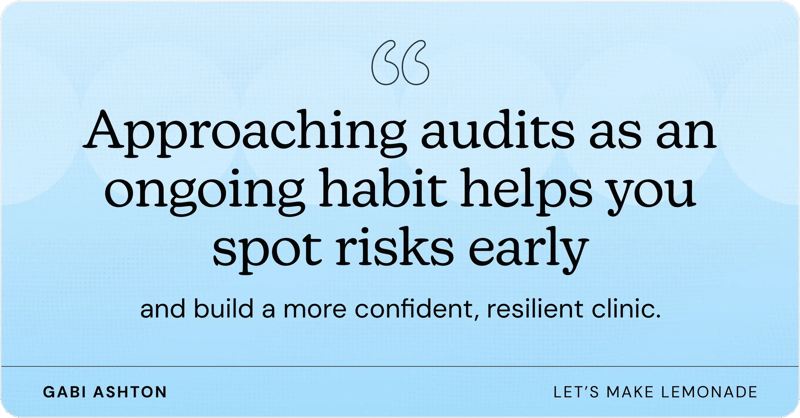
This is particularly important when your service is changing. New systems, new workflows or changes to staffing can all affect care delivery if not properly planned and monitored. If the CQC can see that change has not been well managed and it’s creating risk for patients or staff, that will always be a concern.
It’s also easy for providers to become too comfortable with what worked in the past. What was considered good five or six years ago might not meet today’s standards. Expectations change, best practice develops and patients rightly expect more. That is why staying compliant means staying curious.
What should always be up to date
Providers often assume the answer here is ‘policies’ and while policies do matter, they’re only part of the picture.
A policy can tell people what your service believes or expects. A good standard operating procedure (SOP) tells people exactly what to do when something actually happens.
That is why I always encourage providers to keep SOPs short, clear and genuinely usable. If a document is too long, too vague or buried somewhere nobody can access, it’s unlikely to support safe day-to-day practice. The best SOPs are practical, easy to find and easy to follow. They should support staff in real time, not exist purely to satisfy a document request.
More importantly, don’t fall into the trap of measuring success by how much paperwork you have created. A folder full of beautiful documents means very little if staff are not following them, or if the outcomes they are supposed to support are not being achieved. Good governance is about behaviour, understanding and results, not volume.
The simple routines that keep services inspection-ready
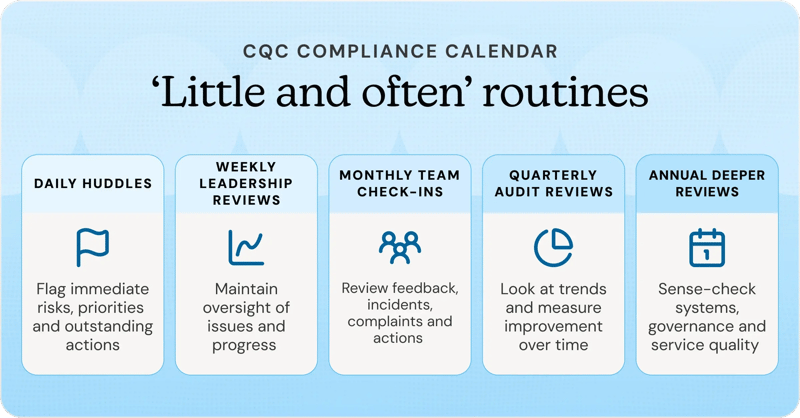
The services that stay strongest over time usually have a few consistent habits in place: a live action plan, regular team meetings and a rhythm for reviewing what’s happening in the service before small issues become larger ones. That rhythm will look slightly different for every provider, but “little and often” almost always works best. It’s about building compliance into your clinic’s culture.
A monthly team meeting can be incredibly powerful if it’s used properly. It gives you a regular space to review whether there have been any complaints, safeguarding concerns, incidents, near misses or themes in patient feedback. It also helps you track what audits are planned, what has been completed, and whether any findings have led to real improvements.
Those conversations matter. They show professional curiosity. They help leaders maintain oversight. And they create the kind of evidence that demonstrates good governance naturally.
For busy practices, a realistic rhythm might include:
- Daily huddles to flag immediate risks, priorities and outstanding actions
- Weekly leadership reviews to maintain oversight of issues and progress
- Monthly team check-ins to review feedback, incidents, complaints and actions
- Quarterly audit reviews to look at trends and measure improvement over time
- Annual deeper reviews to sense-check systems, governance and service quality
The areas small teams most often struggle with
For solo clinicians and smaller providers, the biggest risks aren’t the clinical work itself, but the governance around it.
Complaints, audits, recruitment, training records, staff supervision, appraisals and patient feedback are often the areas that slip first. That’s understandable - most clinicians are naturally drawn to patient-facing work, not the non-clinical responsibilities that come with running a regulated service.
But a CQC-registered business requires both.
If you know you don’t have the capacity or appetite to oversee everything alone, that’s a signal to think carefully about support. That might mean delegating internally, bringing in operational help, leaning on peers or getting external advice where needed. Good governance never means doing everything yourself. It means making sure the important things are owned, checked and followed through.
The warning signs not to ignore
Patient feedback is one of the clearest indicators that something may be slipping. A complaint, repeated concern, drop in satisfaction or change in tone can all point to a wider issue. The same is true for staff wellbeing. Disengaged, frustrated or unsupported staff often signal deeper problems in leadership, communication or service delivery.
If something feels off, don’t wait because it is not yet the ‘right time’ to review it. If there is a concern about safety, effectiveness or quality, look at it now.
Three habits that make ongoing compliance easier
Lean on others. You don’t need to be an expert in everything. Lean on colleagues, peers and trusted advisors. Good governance is stronger when shared and challenged constructively.
Keep your systems simple. In smaller services, you don’t need expensive or complicated software to stay compliant. Secure, organised and accessible systems are often more than enough if they are used consistently.
Don’t put things off. Small concerns become bigger findings when they sit too long. If something needs attention, address it early.
Staying compliant every day
The CQC should never be the reason your service is safe, well-led and responsive. Your patients should be.
When you approach compliance in that way, it becomes much easier to manage. It stops feeling like a separate burden and starts becoming part of how your service protects people, supports staff and improves over time. If your systems help you do that consistently, then you are already doing the work that matters most. That’s exactly what strong ongoing compliance should look like.
.webp?width=800&height=240&name=Article%20Image%20-%20Bio%20G%20(1).webp)
Gabi Ashton has worked in the Health and Social Care sector for over 15 years, in CQC-regulated services and as a CQC inspector. Her experience on both sides of CQC has given Gabi valuable insights into why and how services are rated from Inadequate to Outstanding.
Gabi now runs Let’s Make Lemonade, specialising in CQC compliance with the aim of driving improvements for providers across the health and social care sector.
.webp?width=380&height=201&name=Regular%20CQC%20audits%20(1).webp)
-1.svg)
.webp?width=380&height=201&name=Building%20a%20culture%20(2).webp)