

MANAGING YOUR FINANCES
Building a payment process that supports your private practice
When billing is simple, transparent and built into the patient journey, your practice runs more smoothly behind the scenes. Finance Director Joel Berman shows us how private practices can manage payments their confidently and protect financial stability.
 |
Joel Berman Finance Director, Refuah Medical Centre |

One of the biggest surprises for clinicians moving into private practice is that a busy clinic doesn’t always mean a financially healthy one. You can have a full diary, happy patients and still find yourself under pressure if patient invoices are delayed, insurance claims are slow or appointments go unpaid.
That’s why I always encourage new practice owners to think about patient billing and patient payments as part of the patient journey, not just the back-office admin.
Today’s patients expect the financial side of healthcare to feel much more like the rest of their lives: clear, digital and frictionless. They want to understand the cost before they attend, pay easily by card, receive receipts automatically and know that insurance paperwork is being handled properly.
That shift is good news: when the payment process is simple, patients have a better experience and your cash flow becomes more predictable.
Revenue and cash flow are not the same thing
A clinic may be generating plenty of revenue on paper, but if patients pay weeks later, invoices are sent late, insurers take time to reimburse or there is no clear process for missed appointments, the bank balance can still be under strain.
In smaller practices there's often less of a buffer, so just a handful of unpaid invoices or delayed insurer payments can create real pressure.
The practices that stay stable are not always the busiest, but the ones that make payment feel like a routine part of practice management. In practical terms, that means deciding how and when patients pay, communicating it clearly and using systems that make it easy to follow through consistently.
Decide your payment rules before you see your first patient
If you do one thing before launching, make sure you set your payment rules early. It’s much easier to set expectations early than to tighten them later, so keep it simple.
You should decide:
- Which services are paid upfront and which are paid on the day
- Which, if any, may be invoiced afterwards
- When deposits apply
- What your cancellation window for patient bookings is
- How you handle insurance patients
And then stick to it. The more exceptions you create, the harder it becomes to manage. Consistency protects both your time and your relationships with patients.
Introducing payment as part of the booking process will make the whole process far easier. By the time a patient attends, they should already know what the appointment costs, when that payment is due and how they’ll pay and what happens if they don’t attend the appointment.
When that’s clear, financial conversations become clinic policy rather than a personal negotiation.
Don’t be afraid to talk about money clearly
Many clinicians, especially those coming from an NHS background, feel uncomfortable discussing fees. That’s completely understandable. But in private practice, avoiding the conversation usually creates more tension, not less.
Patients are generally happy to pay when the process feels fair and transparent. What undermines trust is surprise. So rather than apologising for fees, focus on clarity.
Show consultation fees clearly on your website, confirm them again at booking and include payment terms in appointment confirmations. Explain likely additional costs early if tests, scans or follow-up treatment may be needed.
When should patients pay upfront?
There is no single rule for patient invoicing that works for every clinic, but a simple framework helps.
Upfront payments usually work best for fixed-fee, routine or predictable services, like GP appointments, initial specialist consultations, vaccinations or health assessments.

Post-treatment invoicing makes more sense when the scope could change during the consultation, such as recommending blood tests, imaging, procedures or medication that cannot be priced accurately in advance.
Insurance patients often need a slightly different process too, because billing may depend on authorisation and insurer rules (make sure you check this first as patients often don’t know what’s included in their cover). In reality, it’s completely normal for most practices to end up with a hybrid model.
Deposits, card details and protecting clinic time
If there is one area where new practices lose money without realising it, it’s unprotected appointment time. Deposits can make a real difference, especially for longer appointments, high-demand slots and procedures that require preparation.
Even a modest deposit reduces ‘did not attend’ (DNA) rates, because it encourages patients to either attend or cancel in time. Some practices also take card details at the time of booking, like a hotel secures a reservation. You just need to ensure your payment and cancellation policy is explained clearly before the patient books.
The payment methods patients now expect
For most practices, patients now expect the same convenience they get elsewhere. That usually means:
- In-person card payments (including Apple Pay or Google Pay)
- Online card payments
- Payment links for invoices sent after the appointment
- Insurance billing where relevant
Bank transfers still have a place, but they’re usually slower and harder to reconcile. For higher-value treatments, some practices also offer flexible payment options, such as staggered payments, where appropriate.
In some sensitive areas of healthcare, such as sexual health, some patients may prefer cash to avoid a digital record on a bank statement. That may or may not be relevant to your specialty, so understand your patient population rather than assuming one size fits all.
Good billing should feel boring
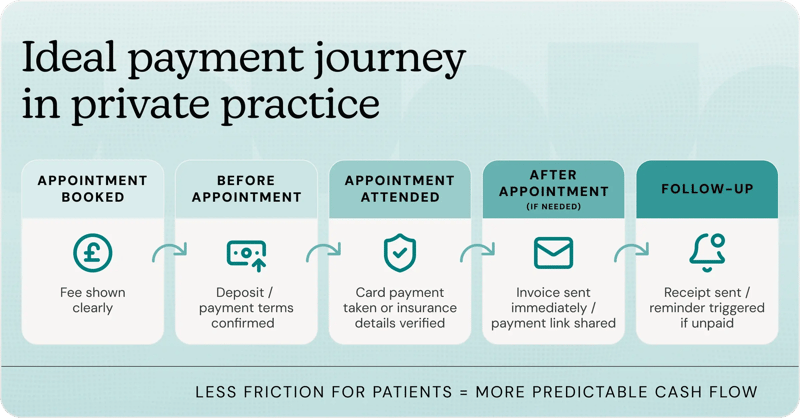
A good billing system should simply make the right thing happen automatically. The best setups also reduce mistakes, because invoices, receipts and payments are linked to the appointment and recorded automatically rather than being chased manually later.
At a minimum, your patient billing software setup should allow you to:
- Generate invoices quickly or automatically
- Link payments to patient records
- Support insurance billing if needed
- See outstanding balances easily
- Review clear financial reports
If you can’t answer simple questions such as who owes money, what is overdue and which services are performing best without using spreadsheets or manual reconciliation, your process is too complicated.
This is where many practices get caught out. In an attempt to save software costs, they manage billing manually using Word or Excel. It feels cheaper at first, but the cost reappears in staff time, delayed collections, poor visibility and avoidable errors. This will ultimately make it harder to scale.
How to prevent debt before it starts
The best protection is simple:
- Collect patient payments before they leave when possible
- Send patient invoices immediately if payment is not taken on the day
- Automate reminders
- Have a clear cancellation policy for patient bookings
As a rule of thumb, invoices older than 30 days should be getting attention. Once they reach 60–90 days, recovery becomes much harder.
If you do need to chase payment, keep it calm and structured: start with a friendly reminder and a follow-up with the invoice attached, then direct contact and a final notice before you escalate.
Formal debt recovery should be rare and only really considered when the amount is meaningful and the patient is unresponsive. Prevention is always better than recovery.
What healthy cash flow actually looks like
Healthy cash flow doesn’t mean having a big bank balance. It means being able to cover your core costs comfortably and predictably.
You should know your main fixed overheads such as rent and insurance, and your key variable costs, such as clinician sessions or stock. Over time, you’ll also start to learn the rhythm of your clinic:
- Are some days naturally busier than others?
- Is demand seasonal?
- Do you pay rent quarterly?
- Do insurers create delays at certain times?
That understanding helps you build a buffer and avoid unnecessary financial stress.
If your clinic is growing, remember that costs change too. Early on, the big expenses are often premises, equipment and staffing. As you scale, technology, compliance, administration and maintenance tend to become more important.
It’s also worth remembering that financial protection is not just about billing. Before launching, make sure the essentials are in place from an insurance perspective, such as liability and clinical negligence cover, plus cyber cover where relevant. Just as importantly, protect the business operationally: use sensible controls around payments and access to funds, and be careful not to tie up too much cash in stock or supplies you may not need straight away.
If you take anything away from this article, please remember this: payment should never feel like an afterthought. Good billing is not just about getting paid. It is about protecting time, reducing friction and giving your clinic the stability it needs to deliver excellent care.
Your first 30 days: Create a process that scales
- Set a clear payment policy for upfront fees, deposits, cancellations and post-appointment billing
- Decide which services are fixed-fee and which may need follow-on charges
- Make sure fees are visible on your website and booking flow
- Put a process in place for missed appointments and late cancellations
- Choose a billing setup that can generate invoices, track outstanding balances and support insurance billing if relevant
- Decide which financial metrics you will review and when (for example: revenue and outstanding invoices monthly; average revenue per appointment, revenue per clinician and DNA rate weekly; profitability and trends quarterly)

Joel Berman is Finance Director at the multidisciplinary clinic, Refuah Medical Centre. A seasoned Finance & Operations Director with over twenty years' experience, he holds several retained positions at senior and board level for companies in medical and insurance fields.
Joel maintains a strong focus on business automation and AI on behalf of his clients. Additionally, he dedicates substantive time both professionally and as a volunteer to the third sector, completing four years as the Chair of Finance Trustee at a London-based Multi-Academy Trust in December.





.svg)