

HOW TO PASS YOUR CQC INSPECTION:
The practice walkthrough: Do’s and don’ts for inspection day
For many practices, inspection day brings understandable nerves, even when the preparation has been thorough. Having a practical plan for the walkthrough can help the day run more smoothly for everyone involved.
 |
Dr Jonathan Andrews, CQC Compliance Consultant, Govanta Compliance |
.webp?width=1328&height=702&name=Dos%20and%20donts%20(1).webp)
The day of a Care Quality Commission (CQC) inspection can feel daunting even for the most organised practices. But with the right approach and a clear understanding of what’s expected, you can be sure the experience runs smoothly for both your team and your inspectors.
From staff behaviour to answering inspector questions, here’s a practical guide to the do’s and don’ts of the practice walkthrough.
Health and safety: Set the scene
Do…
Ensure all areas are clean, uncluttered and hazard-free. Inspectors will be looking for a safe environment for both patients and staff. Have a slow walk through your practice before they arrive: look for trip hazards, blocked exits or unsecured equipment. Remove out-of-date stock and any old medical resources.
Check signage and safety equipment. Are fire exits clearly marked? Is emergency equipment, like defibrillators or first aid kits, accessible and in-date?
Check your cupboards. Are the medical supply cupboards locked? Is there a robust stock control system in place? Are the keys to such cupboards stored securely?
Prepare infection control evidence. Make sure hand hygiene stations are filled and cleaning schedules are up-to-date and available.
Check your incident book is available and in a recognised location.
Make sure you have a designated isolation room, with clear policies for its use.
Always keep accessibility in mind. Ensure hearing loops are working and signposted, and that information is accessible to all patient groups.
Don’t…
Ignore maintenance issues, even if they seem minor. Inspectors will notice details. Start planning for these in advance to get these fixed in good time.
Leave confidential documents in public spaces. It might seem obvious, but it’s not unheard of! Have several members of your team complete a walkthrough - you will all have different priorities of what you’re looking for, which’ll make spotting mistakes far easier.
Staff behaviour: Calm, welcoming and professional
Do…
Brief your team. Everyone should know what to expect, who the inspection team are and their role during a visit.
Make sure all staff are aware they may be approached. The inspection team will have questions about their role, safeguarding, complaints, chaperoning and confidentiality.
Arrange for a Patient Participation Group (PPG) member to be available. A PPG is typically a group of volunteer patients, the practice manager and one or more of the clinicians who will meet regularly to discuss improvements to the service. One member at least should be there to meet the inspectors if possible.
Be polite and welcoming. A positive first impression sets the tone. Greet inspectors at the door and offer them refreshments.
Stay calm and positive. Remember, CQC inspections are about quality improvement, not passing or failing.
Don’t…
Panic or become defensive. Inspectors are there to help improve care, not catch you out.
Allow staff to ‘hide’ or avoid engagement. Everyone should be visible and approachable.
Leave staff unprepared. It’ll be hard for your staff to answer questions if they haven’t been properly briefed. Ensure you’ve scheduled several meetings with staff in the lead-up to a potential inspection so they have time to acclimate to what’s expected of them, as well as your morning-of briefing, so they feel comfortable speaking to the inspector.
Scare your team. Inspections are stressful, but there’s a risk that your pep talks could turn into something that feels intimidating - and as we said, we don’t want staff to hide! Keep conversations and feedback positive and constructive, so your team can feel confident and positive in return. Encourage everyone to be proud of the care you provide and to share their successes.
Answering questions: Clarity and confidence
Do…
Be prepared to explain what makes you outstanding. Sometimes the simplest questions are the ones you don’t prepare for. If the inspector asks, “Why do you think you should be rated Outstanding?” Have an answer ready. Think about your strongest areas. Talk about your values. Give examples of your high standards of care from things like patient feedback surveys or external awards.
Listen carefully and answer only what is asked. If you’re unsure, ask for clarification and take your time - don’t panic!
Use real examples. Illustrate your answers with specific, recent cases where possible.
Be co-operative. If you don’t know an answer, say you’ll find out or get a colleague who can help, rather than just saying “I don’t know” or “that’s not my role”.
Be ready for specific questions about your policies and procedures, staff training, safeguarding and how you involve and respond to patients.
Reflect on feedback. Inspectors may offer suggestions during the walkthrough, so treat this as a valuable learning opportunity.
Don’t…
Give rehearsed or ‘textbook’ responses that don’t reflect your actual practice. No one knows your practice better than you - let that knowledge shine through.
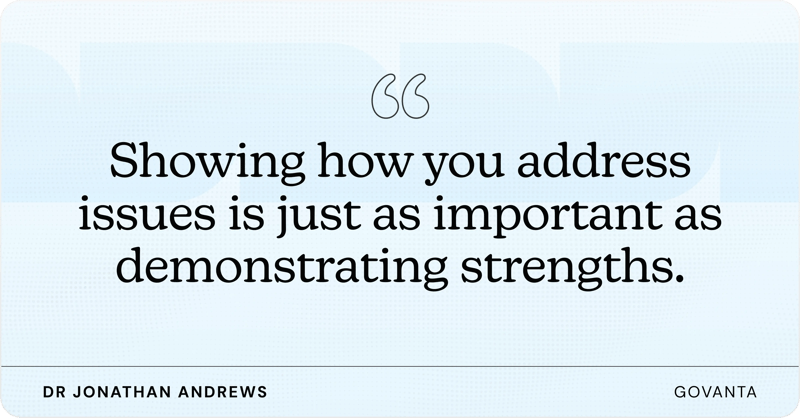
Be afraid to admit challenges. These are a common part of clinical life. Showing how you address issues is just as important as demonstrating strengths.
Try to wing it. Ask for clarification if you need it. Sometimes people use slightly different terminology and it’s ok to request more information or context.
Be afraid to ask the inspector if they couldn’t find the information they needed, or struggled to speak to a member of staff. It shows you to be open and could even close the loop on something that might have brought your rating down.
Presenting information: Organisation is key
Do…
Prepare key documents in advance. This might include policies, audits, complaint logs, training records and safeguarding evidence. Have them organised and easy to access, either digitally or as hard copies.
Check the quality of your paperwork. Missing parts of a person’s care record are a definite no-no. Care plans should be reviewed and updated frequently. Check that risk assessments have sufficient detail, that information from risk assessments and care plans match up.
Label and date everything. Make it easy for inspectors to see what’s current.
Nominate a ‘go-to’ person. This is usually the registered manager, practice manager or CQC lead, someone who knows your systems well and can quickly locate evidence or answer operational questions on the day.
Consider creating a shared resource. Digitally or on paper, so all compliance documents are easily accessible to the team.
Set up information ‘zones’ in your reception or on your website, displaying key compliance documents, patient feedback (“You said, we did”), safeguarding and quality improvement work.
Display your CQC registration certificate in a public area.
Be ready to show evidence of emergency preparedness. Such as your doctor’s bag, emergency drugs and fridge temperature logs. Be ready to discuss controlled drug storage and risk assessments.
Bring your tech into the mix. CQC inspectors will be keen to see the systems you’re using and how it benefits the people you care for. How is it improving outcomes? Can you prove it? Make sure all relevant staff are fully up-to-speed with how to use your tech on the day.
Don’t…
Overwhelm inspectors with unnecessary paperwork. Give them what they ask for and keep additional information close by for if and when it’s needed.
Leave gaps in your evidence. If something isn’t up-to-date, be open about it and explain your plan of action.
This is your chance to show what good care looks like every day
It’s important to remember that your inspector isn’t assessing whether or not every provider runs their service in the same way. It’s not about achieving perfection; they know it’s impossible for everyone to know everything. The aim is to see you’re delivering care to a high quality. It’s your job to show them how you do this.
Preparation is your best defence against inspection day nerves. By staying organised, honest and positive, you’ll create an environment where your team can shine and your practice’s strengths are clear.
Remember, CQC inspections are about everyday quality, not just a one-off event. Good luck!

Dr Jonathan Andrews is a Medical Director and practising doctor working across both the NHS and private healthcare. In addition, Jonathan also leads Govanta Compliance, a CQC consultancy dedicated to demystifying the inspection process and helping practices achieve successful outcomes. He advises start-ups and scale-ups and delivers educational services across a broad range of topics.




.webp?width=380&height=201&name=Building%20a%20culture%20(2).webp)
.svg)