

MANAGING YOUR FINANCES
Setting your financial foundations in private practice
A well-run clinic needs strong financial foundations, even if they start with just a few simple good habits. Chartered accountant Elizabeth Stutt looks at the early decisions that matter most in practice management, helping you create a setup that feels manageable now and sustainable over time.
 |
Elizabeth Stutt Chartered Accountant, Sandison Easson |

For many clinicians, the financial side of private practice is the most unfamiliar part of launching a clinic. Clinical training prepares you for patient care, not tax structures, business banking and compliance deadlines.
The good news? The financial foundations of a clinic don’t have to be complicated. Most early mistakes happen not because finance is inherently difficult, but because no one explains what actually matters at the beginning.
With the right setup from the start, the financial side of running a clinic can feel predictable and manageable. This guide will walk you through the essentials: what to set up first, the common pitfalls to avoid and how the right medical accountant can make the process much easier.
Start with the right business structure
One of the first financial decisions when launching a private clinic is choosing the right business structure.
In healthcare, this usually means deciding whether to operate as:
A sole trader: This is the simplest structure. You run the business personally and keep the profits, but you’re also taxed on all those profits each year.
A partnership: Two or more clinicians run a business together and share profits based on an agreed structure. A clear partnership agreement is essential to define responsibilities and how income is split based on this.
A limited company: A separate legal entity that pays corporation tax on profits. Clinicians then choose how to take money out of the company (for example through salary or dividends), which can offer more flexibility in tax planning.
Expense-sharing arrangement: Common when clinicians want to share costs such as rooms or administrative staff, while keeping their income separate. Each person contributes to shared expenses but runs their own practice.
Each option has different implications for tax, liability and long-term planning. The best structure for one clinician may not be the best for another.
Your plans for the future often influence this decision. For example:
- Whether you may want to sell the business one day
- Whether you might bring in partners later
- Whether you want to share the business with a spouse or family member
Because of these long-term implications, this is one decision that’s worth getting professional advice on early. Once the structure is in place, everything else - bank accounts, paperwork, insurance and tax registration - becomes much easier to organise.
Keep your personal and business finances separate
One of the simplest habits that protects clinic finances is keeping personal and business money separate from the start. Even if you’re operating as a sole trader, it’s good practice to have dedicated business accounts.
Most clinics benefit from having:
- A business current account for income and expenses
- A separate savings account for tax
Setting aside money for tax each month removes a lot of stress later. Instead of scrambling when a tax bill arrives, the funds are already waiting.
A medical accountant can help estimate how much you should set aside so there are no surprises.
Understanding how tax works in private practice
Moving from a salaried NHS role into private work often means adjusting to a different tax system. When you're employed, tax is deducted automatically from your salary each month. In private practice, tax is typically paid twice a year.
The two main payment dates are 31st January and 31st July. The January payment usually includes:
- Your final tax payment for the previous year
- A 50% advance payment toward the following year’s tax bill
The July payment is the second 50% advance payment.
Because of this system, clinicians sometimes experience their first large tax bill later than expected. For example, someone starting private work in April 2026 may not make their first payment until January 2028.
This delay can catch people out if they haven’t been setting money aside along the way.
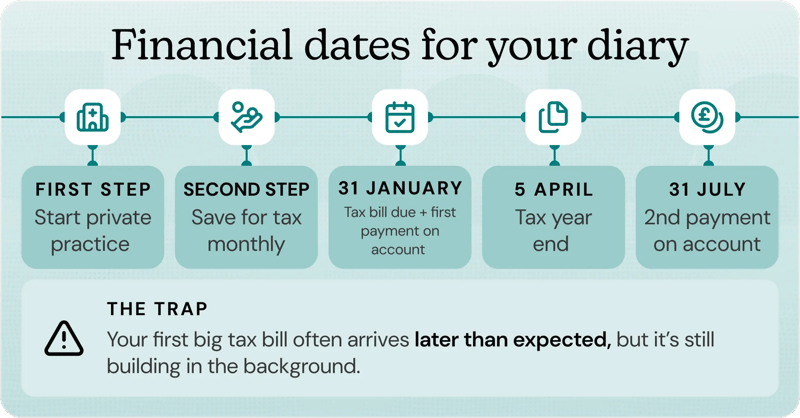
Another key date for your diary is the end of the tax year on 5th April.
Submitting your financial information to your accountant soon after the end of the tax year can make planning much easier. It gives you early visibility of any tax liability and more time to prepare. Many clinicians also benefit from booking a pre-year-end planning meeting with their accountant each year to review income, expenses and pension allowances.
It’s also worth being aware that Making Tax Digital is being introduced in stages from April 2026, which will require many sole traders to submit financial information to HMRC quarterly using approved software. Depending on when you launch your clinic, and your level of turnover, this may apply to you.
Starting with simple digital records now will make that transition much easier.
When VAT, payroll or corporation tax might apply
Not every clinic needs to think about these immediately, but they can become relevant as your practice grows.
For example:
VAT: Most medical care is VAT-exempt, but some services, such as medico-legal work, can be subject to VAT. Once VAT-able income exceeds £90,000 within a 12-month period, registration becomes mandatory.
Payroll: If you employ staff, you’ll need a payroll scheme. Some clinicians also use payroll when employing a spouse or family member who works in the business.
Corporation tax: If you operate through a limited company, the company itself will pay corporation tax on its profits.
These rules can feel complex at first, which is why many clinicians rely on specialist advice as their practice evolves.
A simple monthly financial check-in
You don’t need complex reporting to keep a clinic financially healthy. A short monthly check-in is often enough for the financial side of your practice management system.
This could include making sure bookkeeping is fully up to date, checking that invoices have been paid, paying any outstanding supplier bills and comparing bank balances against expected cash flow.
This kind of routine helps clinic owners stay close to their numbers without turning finance into a full-time job.
Common financial mistakes (and how to avoid them)
Many financial mistakes in new clinics are surprisingly simple and very preventable. Some of the most common include:
Leaving tax planning too late: Waiting until the tax deadline often means not having enough time to save.
Forgetting to set aside money for tax: Regular savings make tax bills far less stressful.
.webp?width=800&height=419&name=Medical%20accounting%20-%20Quote%20(1).webp)
Mixing personal and business spending: This can create accounting complications, especially for limited companies.
Not keeping proper financial records: Poor records can mean missing out on legitimate tax relief on expenses.
Undercharging for services: Pricing that hasn’t been reviewed properly can undermine the sustainability of the clinic.
With the right setup and a supportive accountant, most of these issues can be avoided entirely.
The value of a medical accountant
Many clinicians first speak to an accountant when they need a tax return completed.
In reality, the most helpful time to involve a medical accountant is before you begin private practice.
A specialist medical accountant understands how private practice works, how clinicians are paid and how the NHS pension interacts with private income. That experience can make early decisions much easier.
They can also offer practical advice on things like:
- Tax planning
- Bookkeeping systems
- Pension allowances
- Cashflow forecasting
- Retirement and succession planning
Because they often work with many clinicians in the same specialties, they can also provide helpful benchmarking and insight into how similar practices operate.
Choosing the right accountant
Not all accountants have experience working with healthcare professionals. If you’re choosing one, it’s worth asking a few simple questions:
- Are they qualified and regulated by a professional body such as ICAEW or ACCA?
- How much experience do they have working with medical professionals specifically?
- Do they understand the NHS pension scheme and its tax implications?
- Will you have a dedicated contact person within the firm?
Working with someone who understands the medical profession can save a lot of time and confusion later.
Financial confidence comes with clarity
Running the financial side of a clinic may feel unfamiliar at first, but it becomes much easier once the right foundations are in place.
Most clinicians don’t need to become financial experts to run a clinic. They simply need clear systems, good records and trusted professional support when needed.
With those pieces in place, finance stops being a source of stress and becomes something far more useful: a way to understand and support the long-term health of your clinic.
Your first 30 days: Financial setup checklist
In the first month, the goal is simply to get the financial basics in place.
A few practical steps can make a big difference:
- Register for Self Assessment with HMRC (your accountant can do this for you)
- Choose simple bookkeeping or medical billing software
- Start recording income and expenses from day one
- Set up a system for saving tax each month

Elizabeth Stutt is a Chartered Accountant (ICAEW) at Sandison Easson Specialist Medical Accountants, the only accountancy firm recommended by the BMA. She has worked with doctors since 2009 and specialises in supporting GPs and consultants with accounts, tax planning and financial strategy for private practice.