

HOW TO PASS YOUR CQC INSPECTION:
What to expect at your CQC inspection
Being prepared is the key to any successful inspection. Understanding what inspectors look for, how evidence is gathered and how ratings are determined allows you to take control of the process and showcase the quality of care you deliver every day.
 |
Dr Jonathan Andrews, CQC Compliance Consultant, Govanta Compliance |

Why do inspections matter?
CQC inspections exist to make sure your service is safe, effective, caring, responsive and well-led. These inspections protect patients, support improvement and give the public confidence in your service. Being prepared helps you demonstrate the quality of care you provide every day.
All providers delivering a regulated activity, from GP practices and nursing care to diagnostics or medical treatments, must be registered with the CQC and meet their standards. Failing to comply can have serious consequences, but knowing what to expect takes a lot of the stress out of the process.
What are the types of inspections?
Inspections vary depending on the type of service, your previous ratings and the CQC’s risk analysis.
- Announced comprehensive inspections: Usually for NHS trusts, GP practices, adult social care or specialist services. These inspections cover all areas of your service and are used when access to key staff, records, schedules and operational oversight is important.
- Focused inspections: Smaller and targeted, often following concerns raised during a previous inspection or changes in ownership or management. They don’t always cover all five key lines of enquiry.
- Unannounced inspections: More likely for smaller or lower-risk services. Sometimes CQC visits without prior notice; these are more likely when seeing the service in its normal state is more important, or where there may be concerns about risk, safety, or quality.
How much notice you get varies, but for announced inspections, you can usually expect a minimum of two weeks. Use this time wisely to ensure key staff like your Registered Manager or Nominated Individual are available.
What is the CQC’s assessment framework?
The CQC used to have three different assessment frameworks: one for hospitals, one for adult social care and one for primary medical services.
Since the end of 2023 this has been streamlined into one Assessment Framework. The aim is to simplify the process and provide a single, overall set of expectations, with a clearer understanding of what constitutes a ‘good’ service and ‘quality’ care. This framework applies to all providers, local authorities and integrated care systems.
However, changes are coming: at the end of 2025, the CQC said it’s reviewing its assessment framework and methodology, with its immediate focus placed on actions until the end of 2026, and longer-term planning for delivering the proposed changes up to the end of 2028.
It’s important to keep an eye on CQC’s news channel for the latest updates on what’s changing.
How to prepare for your inspection
Before the inspection, you’ll be asked to provide documentation by email. This could include:
- Policies and procedures
- Staff records and training evidence
- Audits and quality improvement records
- Feedback from patients and staff
It’s worth having all evidence in one central, organised space. This makes it easier for inspectors to see patterns and for you to find what you need quickly.
Many services also give a short presentation to inspectors at the start of an inspection, covering service performance, recent improvements and areas of strength. This is your opportunity to show the story of your service, not just the paperwork.
What will happen during the inspection?
To begin your on-premises inspection, the CQC inspectors will usually meet with the senior staff at your service. This will involve the inspectors providing the scope and purpose of the inspection and how findings will be communicated.
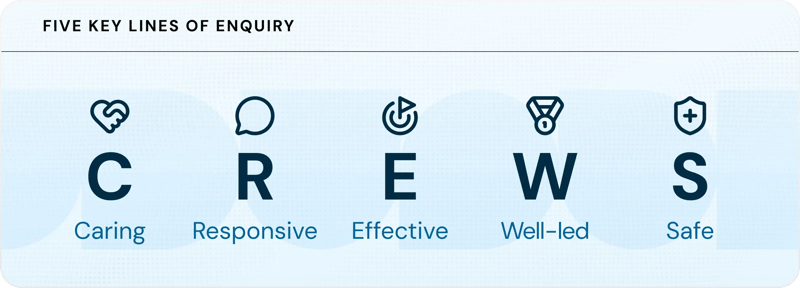
Inspectors structure their visit around the five key questions, which look at whether your service is:
- Caring: Are patients treated with dignity and respect?
- Responsive: Are services meeting patients’ needs?
- Effective: Does care achieve good outcomes?
- Well-led: Is leadership and governance strong and transparent?
- Safe: Are patients protected from harm?
Each key question comes with a set of quality statements and a rating. This will help provide your service with an ‘overall rating’. An easy way to remember these questions is with the acronym CREWS:

- Kindness, compassion and dignity
- Treating people as individuals
- Independence, choice and control
- Responding to people's immediate needs
- Workforce wellbeing and enablement

- Person-centred care
- Care provision, integration and continuity
- Providing information
- Listening to and involving people
- Equity in access
- Equity in experiences and outcomes
- Planning for the future

- Assessing patients’ needs
- Delivering evidence-based care and treatment
- How staff, teams and services work together
- Supporting people to live healthier lives
- Monitoring and improving outcomes
- Consent to care and treatment

- Shared direction and culture
- Capable, compassionate and inclusive leaders
- Freedom to speak up
- Workforce equality, diversity and inclusion
- Governance, management and sustainability
- Partnerships and communities
- Learning, improvement and innovation
- Environmental sustainability

- Learning culture
- Safe systems, pathways and transitions
- Safeguarding
- Involving people to manage risks
- Safe environments
- Safe and effective staffing
- Infection prevention & control
Typically, inspections take two to five hours, depending on the size and complexity of your service.
Get to know inspection day, hour-by-hour.
What are the CQC’s evidence categories?
The other significant recent change over at the CQC is the types of evidence used to assess against the above quality statements.
There are different types of evidence that they will be using to make a determination on these:
Feedback from service users
This is all types of evidence from people using your service, such as feedback forms conducted, direct feedback to the CQC and patient participation groups.
Feedback from staff
This has been expanded in the CQC’s most recent update and is now more critical than ever. Showing evidence from your workforce, such as the results of surveys, will ensure you can generate this evidence. It’s also very useful from a business planning point of view.
Feedback from partners
This is evidence from organisations that your service interacts with to provide care to patients, such as GP surgeries, other local providers, regulators, or multi-agency bodies.
Having a robust survey and feedback process in place for any ongoing partners you work with is crucial to generating this evidence. Consider a simple Google Form being sent out to your key partners once a quarter and tracking the results over time.
Processes
The CQC inspection will also use ‘processes’ as an evidence type. They define processes as ‘any series of steps that are carried out for an organisation to deliver its objectives’.
This includes how organisations measure and respond to quality improvement projects such as audits, and how organisations manage, investigate and learn from incidents. (Think Quality Improvement Processes and incident reporting.)
Outcomes
Outcomes are focused on the impact of care processes on individuals. They cover how your organisation's care has affected people's physical, functional, or psychological status. For example, the CQC will review data on mortality rates, emergency admissions, vaccinations and prescribing data. This can involve national benchmarking.
Observations
The CQC states on its website that “observing care and the care environment will remain an important way to assess quality”. This means that the inspectors will be observing the organisation during the inspection process and making a judgement on the ranking of the service.
This is a more subjective type of evidence, which is dependent on your inspection team. Hence, ensuring the organisation has plenty of other evidence to provide during an inspection is vital.
Feedback and ratings
At the end of the visit, inspectors usually hold a brief feedback session. They might highlight urgent issues or quick wins, but most feedback will come in a draft report within a couple of weeks. Once the report is finalised, it and your rating will be published on the CQC website.
CQC ratings are:
- Outstanding: Exceptional care.
- Good: Meets expectations.
- Requires Improvement: Needs targeted improvements.
- Inadequate: Serious concerns; may result in special measures.
You must display your rating in your service and online if you operate digitally.
The strongest inspections happen when good habits are already part of how your service runs, from keeping records up to date to listening to feedback and acting on it. If you’re organised, clear on what inspectors are looking for and able to show how your service delivers safe, high-quality care, inspections become far more manageable.
Practical tips to make inspections easier
- Plan ahead. Once registered, dedicate time to preparation. Keep your audits, staff training records, policies and feedback up to date.
- Keep everything accessible. One organised space for documentation, audits and evidence makes the inspection less stressful.
- Engage your team. Regularly discuss quality, feedback and improvements. This ensures inspectors see a culture of learning and safety, not just compliance.
- Understand your key questions. Think about how your service demonstrates safety, effectiveness, caring, responsiveness and leadership every day.
- Use inspection as a learning opportunity. Immediate feedback, reports and ratings are not just a score, they’re a guide for continuous improvement.

Dr Jonathan Andrews is a Medical Director and practising doctor working across both the NHS and private healthcare. In addition, Jonathan also leads Govanta Compliance, a CQC consultancy dedicated to demystifying the inspection process and helping practices achieve successful outcomes. He advises start-ups and scale-ups and delivers educational services across a broad range of topics.



.webp?width=380&height=201&name=Facing%20failure%20(1).webp)