
As private healthcare grows, fragmented systems leave people holding the journey together. Here’s what that means, and how care coordination can help.

EXECUTIVE SUMMARY
Private healthcare in the UK is growing faster than most operating models were built to handle. Technology has been the natural response to making this easier and we’ve seen providers adopt point solutions to help: tools built to solve singular, well-defined challenges, like booking systems, AI scribes and reporting tools. And by their own account, it's working. But our new research points to a disconnect: each of these tools is treating a symptom, rather than solving the bottlenecks created by fragmented systems.
Our survey of 250 UK private healthcare leaders reveals that:
estimate they're losing 6-10% of their potential revenue to operational inefficiency.
of admin teams remain stretched to full capacity or beyond, despite adopting tools designed to increase capacity.
use three or more separate systems to manage a patient from first contact through to treatment and payment.
say better integration, automated handoffs or visibility would improve pathway management most, compared with just 23% who want more AI tools.
When these solutions don’t connect, people become the connective tissue.
The tech is making individual tasks faster, but teams are still manually plugging the gaps between each one, chasing information from one system to the next.
This manual effort adds up to a care coordination tax: the cost of people holding fragmented systems together. The complex nature of private healthcare compounds this issue. As providers grow, coordination becomes harder and limits the capacity that this new technology was meant to create.
For large multisite providers, they must rethink how their tech stack supports the entire operating model, rather than becoming a salve for parts of it. Providers need a connected view of how patients move between teams and services, underpinned by the interoperability and governance needed to make new technology, including AI tools, work safely and effectively across the pathway.
This is where care orchestration comes in. By connecting the information and workflows providers already have, it can help coordinate the entire patient journey and remove manual hand-offs across systems and teams.
The real measure of progress comes down to a few basic but crucial questions: Can providers can move more patients through care without increasing admin work? Do they have a clear view of the pathway and exactly where it’s stalled? Can leaders address any bottleneck in care delivery in real time?
The care coordination tax can grow with every new site, service and contract. The providers who lead the next phase of private healthcare will be the ones who stop paying it.

Patient demand is growing, and providers are looking to their tech to help speed up their care pathways.

Private healthcare in the UK is scaling much quicker than the infrastructure built to run it.
The reasons aren't a mystery: NHS waiting times continue to be eye-wateringly high with many specialities stretched to breaking point (some mental health patients are told to expect an eight-year wait for an ADHD assessment).
But patients have simply stopped waiting. This year research found 52% of patients expect to self-fund some part of their diagnosis or treatment on 2026 – and the majority are confident that AI will improve their healthcare experience. The result means self-pay's share of private hospital admissions has grown from a quarter before the pandemic to over a third today, while demand is concentrated in the specialisms where NHS pressure is highest: women's health, private GP, diagnostics and neurodivergence assessments*.
For private care providers, keeping up with that demand is already driving significant changes to how they operate. And healthcare leaders are seeing the results:
*Source: LaingBuisson data, Laing Buisson Private Healthcare Summit 2026
QUESTION 1.
QUESTION 2.
QUESTION 3.
For multi-site groups and hospital-scale providers, that demand doesn’t land gradually. It's complexity and urgency arrives across every site, speciality and referral pathway at once, faster than existing operating models were built to support. And the high costs of care mean private patients have high expectations. “It's not just an appointment,” says Rupa Parmar, GP and Medical Director at Midland Health, a multi-site private GP and multidisciplinary provider. “It's a solution to their healthcare problem, and they want a clear route of getting there.”
Providers have responded by investing in technology: 60% have adopted online booking; 59% now utilise reporting and analytics tools; 52% rely on AI scribes or transcription. That investment reflects the pressures providers are under to absorb more demand without adding the same level of cost and headcount, making individual parts of the patient journey faster and easier to manage.
It appears to be working: 90% say the total time from initial referral to discharge has become faster over the past two years. At the scale multi-site providers operate, that reads as validation: the investment in technology is paying off, task by task, site by site.
What the tech doesn't yet answer is what happens when those tools, and those sites, have to work as one connected system across a workflow rather than as solutions for specific tasks.
Most providers see real value in the point solutions they’ve adopted to keep up with demand, yet revenue is still being lost elsewhere in the patient journey.
So demand for private healthcare has never been higher, and providers can feel it: 86% say patient demand has increased over the past two years. That growth is what makes the care coordination tax important to pay attention to: if you scale to meet demand without fixing how people, processes and technology work together, the manual coordination scales with you.
Sometimes, that coordination tax is literal: 56% of providers estimate they're losing 6-10% of their potential revenue to operational inefficiency. For a large-scale provider running multiple sites and service lines, that cost could potentially be in the millions.
Providers can clearly see the value in the tech being used to mitigate this: 99% consider the technology they've adopted valuable. But that value doesn’t necessarily translate to a more scalable operating model where they can operate efficiently to meet SLAs, improve margins and win new contracts.
QUESTION 4.
Such as unfilled appointments, patient drop-off, delayed referrals or delayed billing.
QUESTION 5.
Ultimately, a tool purchased as a point solution to a specific problem will improve the task at hand, but not how an entire workflow is completed. Clinical documentation can be completed in minutes with AI transcription, but you’ll still have a referral sitting in an inbox for a week because a person must route it to the next step automatically. An appointment can go unbilled because the information needed for invoicing is missing from the patient record.
So a task might be automated, but the processes, people and data around that task still need to connect to a wider workflows and business processes to deliver a scalable operating model. When they don’t, people fill that gap. And the people filling that gap are stretched: 92% of admin teams remained at full capacity.
Beneath the rosy surface of a growing private healthcare business, fragmented tools are leaving admin, finance and clinical teams to manually patch the gaps their tech hasn't closed.
The average provider now runs an average of 3.4 separate systems to manage a patient from first contact through to treatment and payment; 70% use three or more. Despite having more tools to work faster, gaps are still being created across workflows. These can show up differently depending on whether you’re across front of house, clinical or back-office teams.
QUESTION 6.
QUESTION 7.
QUESTION 8.
OPERATIONAL IMPACT
“The biggest friction points come at handovers. In neurodevelopmental care, there can be a lot,” says Jay Biswas, Head of Operations for Neurodiversity at Lighthouse Pathways, a neurodevelopmental provider specialising in ADHD and autism assessments. “Waiting on forms, obtaining GP or school evidence, co-ordinating multi-clinician assessments, moving from diagnosis to medication.”
When a patient moves between teams, tools or stages, delays occur ‘often’ or ‘very often’ for 70% of providers. And if you needed to find out where a specific patient is in a pathway at a point in time, 56% can’t do that by checking just one data source. It’s either by checking two or more systems, pulling together spreadsheets or asking a colleague – sometimes all three.
“For providers, it’s more manual work, more clinical risk,” Jay adds. “Take the titration pathway: a patient may be ready to start medication, but we are still waiting for their blood pressure readings or medication summary from their GP. Clear tracking and coordination are needed to ensure the necessary checks are completed and patients know what's needed before treatment can begin.”
Only 29% of operations and practice managers can check a single system to see where a patient is. The lack of visibility creates bottlenecks that quickly becoming a ceiling on how many contracts, sites or services they can take on without adding headcount.

QUESTION 9.
When a patient moves between teams, systems or stages of the pathway.
QUESTION 10.1
In a typical month, how often does each of the below happen at your organisation?
FINANCIAL IMPACT
58% of finance teams regularly or occasionally lose track of invoices or claims because the information they need is missing or scattered across systems. 61% experience unpaid appointments that go unbilled; a further 61% lose appointment capacity they can't refill in time.
This is the coordination tax finance ends up paying: invoicing information generated in one system, payment information needed in another, and no reliable route between them to see whether an invoice has been paid or not.
QUESTION 10.2
In a typical month, how often does each of the below happen at your organisation?
CLINICAL IMPACT
When clinical information sits across different teams and systems, clinicians struggle to see what has happened elsewhere and determine the optimal treatment plan. This lack of visibility creates another kind of tax across the pathway, where clinical risk and patient safety incidents can creep in.
As Dr Parmar puts it: "It's not only a patient experience issue, it's a governance and patient safety issue. Has the investigation actually happened? Was medication started or stopped? Who's responsible for follow up? As a patient's GP, having visibility as to what happens downstream just feels a lot safer.”
It also means providers can't always evidence – to the NHS, to insurers, to their own board – that every step in every pathway was actually completed, by who and when to reduce medico-legal risks.

COMPLIANCE IMPACT
52% of providers have adopted AI scribes or transcription, but just 39% have a comprehensive, enforced policy governing how those tools access and handle patient data.
“The allure of AI is enticing for an industry under that much pressure,” says Semble’s Head of Information Security, Fay Sears. “But adoption moves at the pace of convenience and governance works at a pace of agreement. Governance takes far longer than an easy tool that could really help right now.”
The chasm between adoption and governance isn't evenly spread either: only 42% of operations and practice managers say their organisation has an AI policy in place, compared with 73% of owners, directors and C-suite leaders. The people closest to how these tools are actually used are the least confident that the guardrails exist. And without those guardrails, every new tool adopted to solve one problem adds to a different one.

QUESTION 11.
Individual tools are solving individual tasks well, but the coordination work across pathways has stayed with admin teams.
During a typical pathway, a patient might move between specialities and clinical teams, with different requirements from consent, reporting and payment at each stage. But patients see their care as a journey, not a series of processes.
“Patients don't really care that they need an MRI and a hearing test and an ENT and a GP and then a prescription,” says Dr Parmar. “They've come with that problem. They expect their provider to join those dots and deliver the solution.”
For providers, this movement creates an operational problem that becomes harder to manage as the business grows. Different specialities, sites and funding arrangements bring different requirements, and each new tool needs to work within that wider picture.
The cost of this is significant. A typical admin team member spends 5.8 hours a week entering or re-entering information, chasing updates between systems or reconciling data across tools. Meanwhile, 57% of providers regularly or occasionally have insurer billing short-paid, rejected or written off because of reconciliation errors.
The question providers need to ask themselves isn't whether a tool works. It's whether it lets you do more with what you already have.
As Jay Biswas, puts it: “Stage-by-stage management can optimise individual appointments, but leaves gaps between those appointments. And when those gaps appear, it creates uncertainty and delays for patients.”
70% of providers already run three or more systems. Another site or contract means the existing model must support more systems, more processes. If those connections still rely on people to hold everything together, growth can bring more coordination work alongside more patients.
For a provider looking to expand, the question stops being what each tool can do and starts being what the organisation can do.
QUESTION 12.
entering or re-entering information, chasing updates between systems, or reconciling data across tools?
QUESTION 13.
does your team typically use to manage a patient from first contact through to treatment and payment?
Providers don't need more tools. Instead, the tools they have must work together as one connected system.
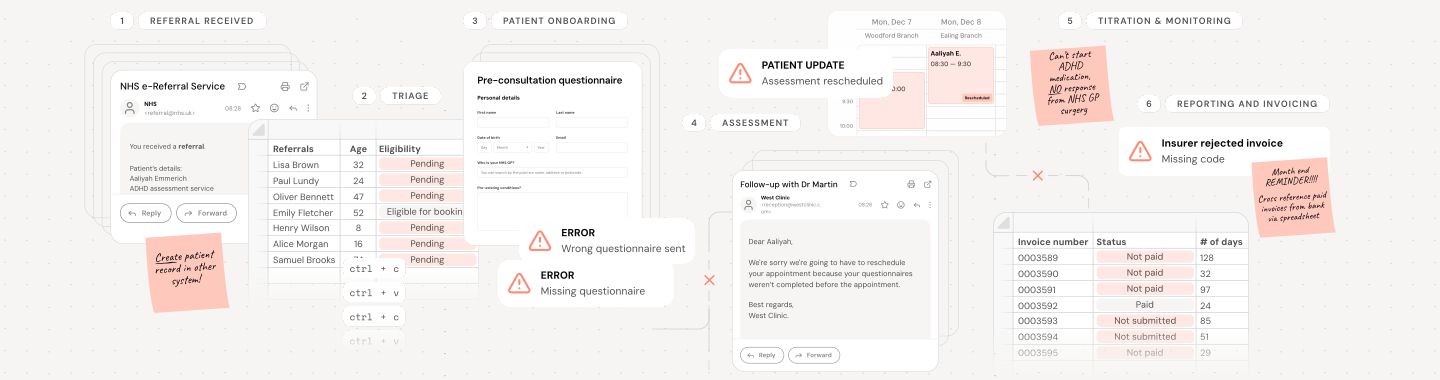
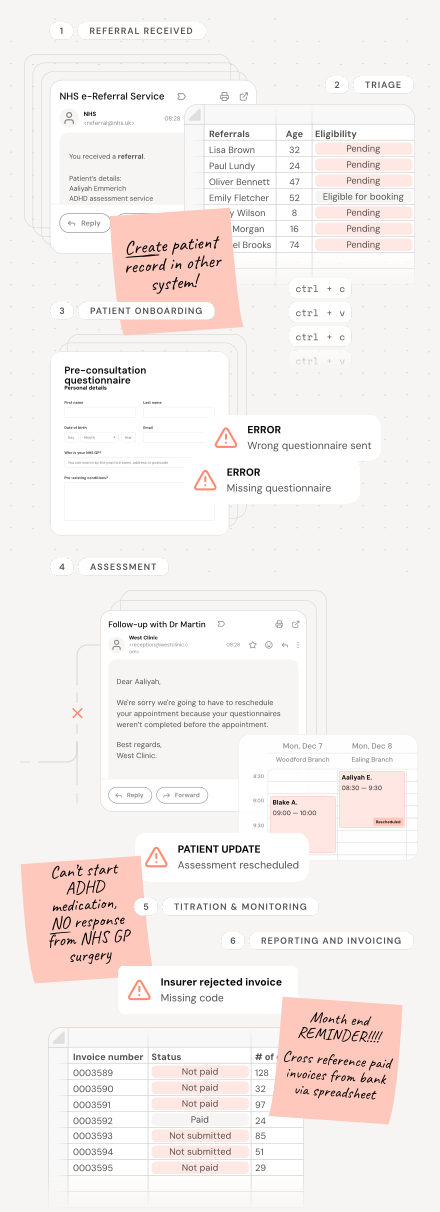
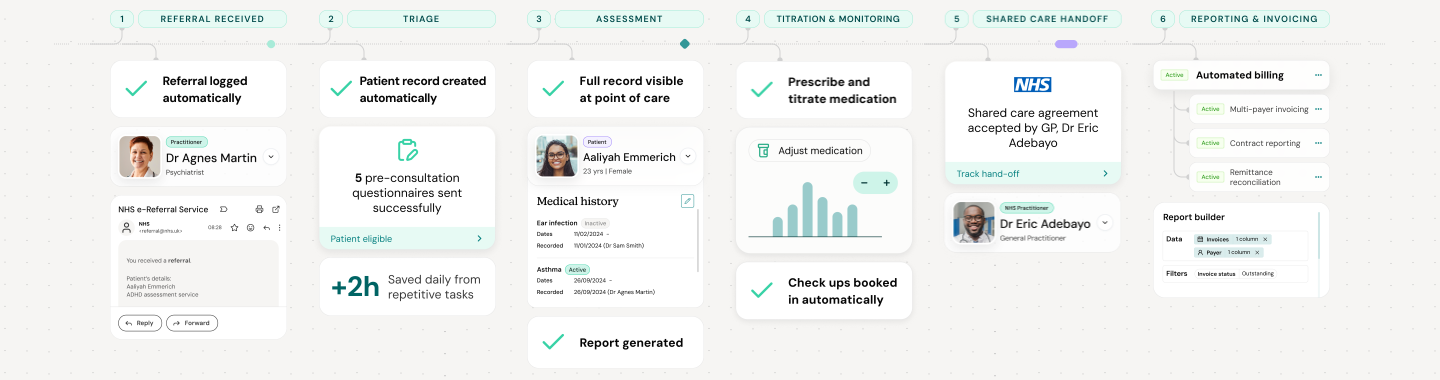
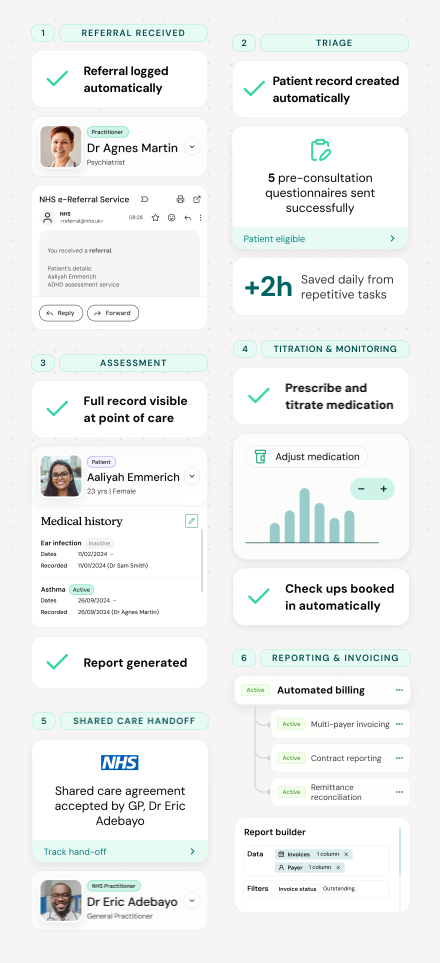
“Digital solutions have helped us book appointments online, send questionnaires, automate communication. We use AI tools to help with administrative and clinical workflows,” says Dr Parmar.
“But that’s about digitising individual steps – it doesn't create one digital patient journey. You still need those individual dots to be joined up.”
So, what actually joins the dots? Healthcare providers were clear: when asked what single change would most improve how they manage patients through the care pathway, 66% said better integration, automated handoffs and clearer visibility of where each patient is. Just 23% asked for more AI tools, and 12% asked for more staff.
QUESTION 14.
Care orchestration is the layer that does this. It connects the people, processes and systems across a patient pathway. Patients, bookings and financial information can move between systems without someone having to re-enter the details. Teams are prompted on next steps automatically. Instead of piecing together progress across different systems, patient progress is immediately visible in the pathway.
That need is highest where the pathway is most complex. Hospitals and large providers run the most services, specialities and systems of any provider type whilst delivering against contracts with SLAs with complex billing and reporting requirements. The bigger the operation, the more that care orchestration matters, and the more expensive it is to go without.
But this isn't a case for uniformity. A cardiology referral looks nothing like a mental health assessment, and a self-pay journey looks nothing like a Right to Choose one. Care orchestration means any healthcare provider can design coordination workflows configurable to how the business operates. This gives a foundation to grow across services, sites and take on more contracts without an increase in manual work.
Building toward the connected pathway with three commitments that turn care orchestration from an idea into infrastructure.
A more connected pathway means creating infrastructure that can carry context between each step, keep care moving across organisational boundaries and support greater scale without adding the same level of administrative overhead.
There are three areas central to this: AI that can work towards an outcome across a pathway, clinical information that can move with the patient and infrastructure designed to make complex workflows repeatable and reliable. Here, three Semble experts walk us through it.
MIKAEL LANDAU, CO-FOUNDER & CHIEF PRODUCT OFFICER

We've become really good at making individual tasks faster. But the patient journey is made up of dozens of these tasks, with people coordinating between them. So, the challenge is making those capabilities work together around the patient.
Task-driven AI starts with an instruction: complete this errand. Intent-driven AI starts with an outcome: this is what I want to be true. It needs to understand where the patient is in that pathway, what's already happened, what needs to happen, what information is missing and which actions need to follow. It's not a set of features; it's connective tissue.
Large providers have so much complexity everywhere, and today humans absorb a huge amount of that complexity. At scale, intent-driven AI gives you another way of absorbing it. It's decoupling the proportionality between scale and coordination overhead.
CHRISTOPH LIPPUNER, CO-FOUNDER & CEO
Right to Choose has made this urgent: patients now move routinely between NHS and private care, often for the same condition. Through our partnership with ORB, Semble already gives clinicians consent-led, real-time access to a patient's full NHS GP record.

Most patients move between the NHS and private care, but their history doesn't always move with them. If a private consultation ends with ‘we need to write to your GP first’, a pathway the patient chose for speed can stall before it starts. That's why we connected Semble with the NHS through ORB Connect. With the patient's consent, clinicians can see their NHS GP record before the consultation starts, so they can pick up treatment where the NHS left off.
When the full picture travels with the patient, clinicians can avoid repeating tests and keep follow-up moving across teams and sites. The patient shouldn't have to think about which organisation holds which piece of their history, and a shared pathway shouldn't mean a shared set of delays. The patient should get the benefits of both.
THOMAS BERNARD, CHIEF TECHNOLOGY OFFICER

When people have to reconcile systems manually, they become the integration layer. A missing field at the start of a patient journey can become a delayed appointment and an unreliable report further downstream. Built for scale means adding a new site should be a repeatable configuration exercise, not a bespoke software change.
The goal is to build quality into the workflow: mapping that workflow with clear definitions for each step, each validation and clear ownership of that data. The infrastructure needs to recognise events like consultations and prescriptions, trigger the appropriate next step, and surface any ambiguity for a decision by the clinician.
If you want AI on top of that, your data model needs to be as clean as possible, because AI needs a tight data model and data governance to operate well: clear ownership, clear change where it happens and traceability. For me, this is what infrastructure should provide.
The next phase of growth will depend on how effectively providers can remove the operational friction that sits between demand, delivery and revenue.
The next few years will test whether private providers can scale without their workload growing at the same rate.
This research shows a sector that has done a lot right. Providers saw demand coming, invested early and are moving patients through care faster than they were two years ago. It also shows where the remaining cost sits: in the hours spent re-keying information, in revenue that slips away before month end and in AI tools running ahead of the policies meant to govern them.
None of that will get easier on its own. The choices leaders make now about what they buy, how they govern AI and how their systems share information will decide whether growth adds margin or adds admin.
The care coordination tax isn't a fixed cost of running private healthcare. It comes down to how the operation is designed, and it can be designed out.
METHODOLOGY
Every statistic in this report comes from 250 UK private healthcare leaders who took the time to tell us what's happening in their organisations. Here's a bit about who they are.
NO. OF RESPONDENTS
Questions

Based
AUDIENCE MADE OF PROVIDERS WITH
Employees
organisation types


