

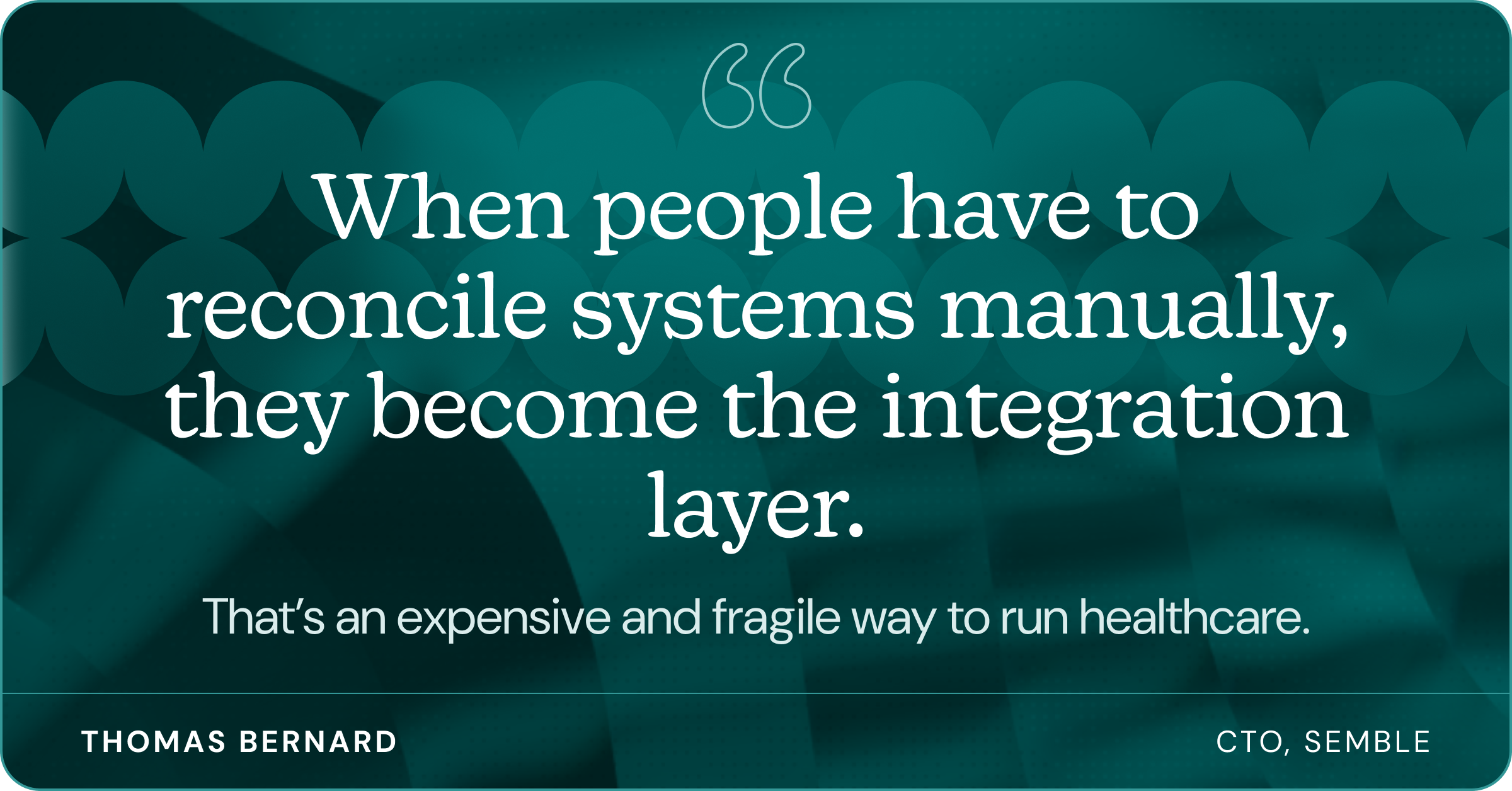
When healthcare staff have to reconcile systems by hand, they become the integration layer. That's expensive, and it's also a fragile way to run healthcare. Much of the important operational context lives in people's heads rather than in the infrastructure. Accuracy relies on optimal individual performance, all the time. If people change jobs or leave, connective knowledge disappears with them.
Our recent survey of some of the UK's largest private healthcare leaders shows how common this is. Admin staff spend an average of 5.8 hours each a week re-entering information, chasing updates and reconciling data between tools. And 70% of organisations use three or more separate systems to manage a single patient journey.
Shared context is the first thing to break as providers grow
Every discipline and team builds up its own knowledge about a patient. An internal medicine team, for example, may know a patient's history well. When that patient moves on to cardiology, much of that knowledge stays behind. That's when blood tests and MRI scans get repeated.
Growth tends to add more systems: 28% of hospitals and large providers use five or more separate systems to manage a patient, compared with 10% of single-site clinics.
Each specialist system does its own job well. The difficulty is the new boundary it creates, and the questions that come with it. Which system is the source of truth? What triggers the next task? Who is responsible when two records don't match? The connective tissue between systems is missing.
Each system knows only one part of the patient's story
Typically, one system knows about the appointment. Another knows about the consultation. A third knows about the invoice. Each may hold a lot of information, but none of them has a shared operational picture of the whole journey: where the patient is and what should happen next.
Is that a data problem or an integration problem? If only it were just one of them! Connecting systems moves data between them, but staff still have to judge which patient record, status or definition is the right one. Integration moves the data. Good infrastructure makes it trustworthy and useful.
Only 44% of the leaders we surveyed can check a single system to see where a patient is in their pathway. Among operations and practice managers, that falls to 29%, compared with 51% of owners and senior leaders. The people closest to the day-to-day work have the least joined-up view of it.
A gap at the start of a patient journey travels downstream
A missing field in the patient record at the start can become a delayed appointment, a rejected invoice and an unreliable report further down the line. Each adds delay and cost, and can mean a patient waits longer for care.
Over half of leaders (58%) say invoices or claims are delayed because information is missing or spread across systems. A similar proportion (57%) see insurer payments short-paid, rejected or written off because of reconciliation errors.
It's easy to see how data quality matters well beyond the accuracy of the clinical record. Scheduling depends on reliable details about the patient, clinician and location. Invoicing depends on knowing exactly what happened. Together, they decide whether the organisation as a whole runs efficiently.
Good infrastructure contains the complexity
This is where care orchestration comes in. It doesn't replace specialist systems. It works as a coordination layer across them, keeping track of where each patient is. It recognises events, such as appointments and prescriptions, and triggers the next step. It can suggest whether a patient goes back to their GP or on to a cardiologist, and check that any bloods or scans are done first, so the patient arrives at their appointment prepared. Where something is ambiguous, it brings it to a clinician to decide.
That's the approach we take at Semble, working horizontally across the systems a provider already has. The aim is for the infrastructure to handle the complexity, so that what staff and patients experience is simple and seamless.
Growing providers need to get the foundations right before adding AI
My advice to a technology leader at a growing healthcare group is to start here:
Agree what the basics mean for your data model. Define what counts as a patient, practitioner, site, appointment and episode of care (a patient's full course of treatment), who owns each one and when it can change.
Measure data quality at every step of the journey. If a blood test result is missing when a patient moves to the next stage, the gap shows up where it happens and the test can be requested again.
Do both before adding AI. AI performs well only on clean, well-governed data, with clear ownership and a record of what changed and when.
Even better, getting this right can bring further growth opportunities. With a core that is standardised, secure and traceable, and room for local variation on top, adding a new site or specialty becomes a repeatable configuration exercise instead of a bespoke software project.
Our report, The Care Coordination Tax, sets out the full survey findings.
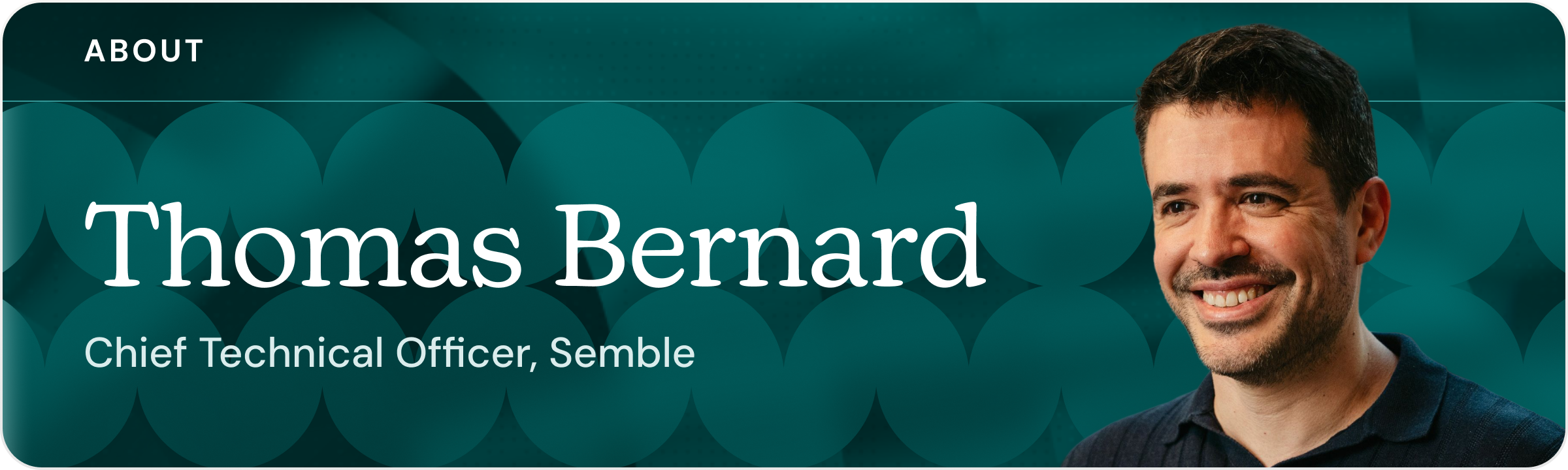
Thomas Bernard is a tech leader with over 15 years of experience delivering innovative, customer-centric solutions. Skilled in fostering and scaling high-performing, diverse and inclusive teams across multiple industries, including web, telecoms, aerospace, television, media, and web tools.
He is currently Chief Technology Officer at Semble, where he looks after software development, AI, data, quality, platform and infrastructure.