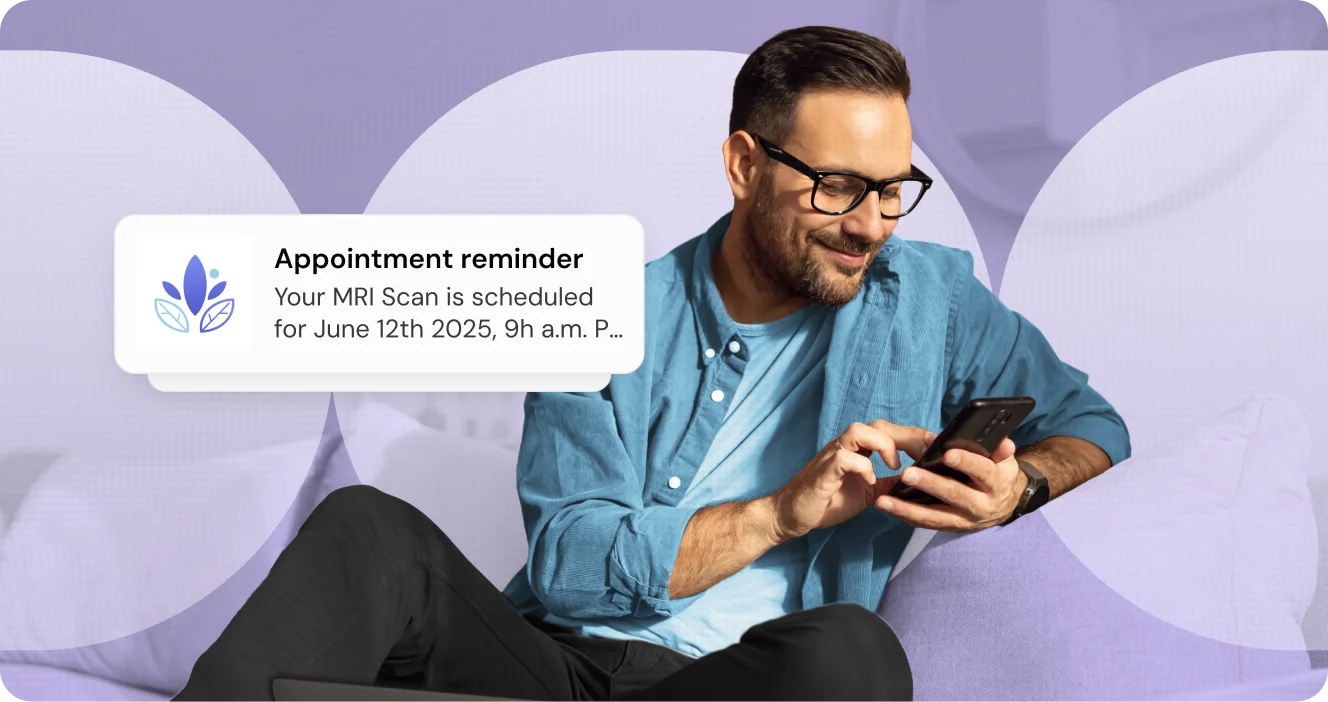


Patient engagement software is often associated with the simple function of reminding someone they have an appointment coming up. This function is important, as missed appointments disrupt care and create avoidable administrative work while leaving valuable clinical time unused. In fact, reminders such as letters, texts and phone calls can reduce no-shows by as much as 80%. However, reminders are only one small part of what patient engagement tech can do.
For enterprise healthcare providers in particular, the bigger opportunity is to create stronger connections throughout the patient journey. That means giving your patients easier ways to provide information before an appointment, access care remotely, receive documents, complete follow-up steps and stay connected with their clinical team. At the same time, those interactions need to work across multiple teams and clinics without creating another disconnected system for your staff to manage.
This is why the most effective patient engagement software doesn’t just improve communication alone, but helps to make ongoing care more joined up across the board.
What is patient engagement software?
Patient engagement software is technology that helps healthcare providers communicate and interact with patients throughout their care. That can include appointment reminders, but its role can extend much further. It can help your patients provide information before they’re seen, access important documents, attend consultations remotely and stay connected with their care afterwards.
The key is that these interactions aren’t isolated. When those interactions sit within the same wider system, the experience feels less fragmented for patients and is easier for your clinical and administrative teams to manage.
For example, a patient might complete an assessment before an appointment, discuss the results during a video consultation and receive follow-up information afterwards. When those stages connect with the patient’s clinical record and a healthcare provider’s wider workflows, your staff have a clearer view of what has happened and what needs to happen next. For your patients, the experience also feels more coherent.
Patient engagement starts before the appointment
It can be easy to forget that good ongoing care begins before the clinician and the patient actually meet. Digital intake forms such as assessments and questionnaires allow patients to provide relevant information in advance, rather than spending the first part of an appointment working through basic details.
This is particularly valuable when your clinicians need substantial background information. Mental health services, for example, may rely on detailed assessments before a consultation can progress effectively. Platforms such as Semble’s telehealth and patient engagement tools allow patients to complete digital questionnaires before their session. The clinician can then begin with context already available rather than collecting it from scratch.
For a larger healthcare provider, structured digital processes also help create consistency. Different locations and teams can gather the information they need without relying on paper forms or email attachments, not to mention separate systems that don’t always work well together. That matters when your organisation is trying to offer a consistent patient experience while still allowing different specialities to collect information relevant to their care.
Make remote care part of the patient journey
Telehealth and remote care has also changed what meaningful patient engagement looks like. Video appointments are growing more and more common, which is why they should feel connected to the care journey and work smoothly alongside other capabilities, rather than being bolted on after-the-fact. Otherwise, when video software sits outside the main clinical system, both sides can encounter unnecessary friction and delays.
Semble, for example, allows your clinicians to launch video consultations from its calendar while accessing patient notes, medication history and laboratory results. Patients can also join through a browser on a phone or a computer without needing to download yet another application.
The important point isn’t simply that video calling is available, but that remote care and video appointments remain connected with the wider patient record. That’s increasingly important for healthcare organisations delivering a mixture of in-person and virtual care across several locations. Your patients may move between the two, depending on their circumstances, but their information and care journey shouldn’t become fragmented along the way.
Keep patients informed after they leave
Just like how patient engagement doesn’t begin when a consultation starts, it doesn’t end when one finishes either. When an appointment is over, a patient may need anything from a prescription or a clinical letter to a medical test or another appointment. They may also need their details shared with another healthcare professional that’s involved in their treatment.
Disconnected systems, however, make that process harder than it needs to be. Clinicians may create documents in one system and send information through another while relying on staff to manually keep track of follow-up actions. Each additional handover introduces another opportunity for delay or lost information.
Strong patient engagement software can reduce those gaps. Semble, for example, allows patient-ready letters and documents to be shared securely, with patients able to access their documents through a patient portal. Prescriptions and laboratory tests can also be ordered as part of the remote care workflow.
Thanks to Semble’s intuitive patient tracking and automatic appointment communications, Consultant Cardiologist Dr Balerdi was able to grow his patient numbers by 30%. The greater continuity between consultation and next steps is essential, as it helps to turn follow-up into part of the workflow rather than another administrative process that your people need to manage elsewhere.
“I wanted to find out how many patients I was looking after, but the answer came with about 50 sheets of paper. There was no way to extract the data in any electronic format, so I was flying blind for the first few years of private practice.
It’s important that we don't lose these people, because if the valve starts to go wrong, the patient goes wrong. So it's imperative that we keep them under a follow-up pathway.”
- Dr Matthew Balerdi, Consultant Imaging Cardiologist
Reduce the friction that makes engagement harder
Patient engagement isn’t only about giving people more ways to interact with a healthcare provider. Those interactions also need to be easy. Asking your patients to download unfamiliar software and manage several logins or repeatedly provide the same information can work against engagement rather than strengthen it.
The same applies internally. A patient experience might appear straightforward from the outside while your administrative and clinical teams are moving between calendars, video platforms, electronic health records, forms and communication tools behind the scenes. That fragmentation matters because operational inefficiency eventually reaches the patient. Information takes longer to find and follow-ups require more chasing, while your teams have less visibility over what has already happened.
This is why, for enterprise providers, the ability to connect systems becomes increasingly important as operations grow. Semble’s connected healthcare management platform brings practice management, electronic health records and patient-facing workflows closer together. It also connects with more than 1,200 external business tools, allowing your organisation to integrate areas such as customer relationship management, business intelligence and human resources rather than forcing every workflow into another silo.
Build a consistent patient experience across multiple sites
Managing patient engagement in one clinic is very different from managing it across a healthcare group. As a multi-site provider, you may have different specialities, locations, teams and patient pathways operating simultaneously. Without clear processes in place, each location can gradually develop its own way of handling forms, communication, follow-ups and remote appointments.
Some variation will always be necessary. A dermatology pathway won’t look the same as a mental health one. However, variation shouldn’t mean fragmentation. Enterprise patient engagement software can give your organisation a common infrastructure while still allowing individual services to adapt workflows to their individual clinical needs. Questionnaires and reminder templates, for example, can be tailored to suit how each clinic works.
This helps your organisation standardise where consistency matters without making every patient journey identical. It also gives operations and medical leaders better oversight. Instead of trying to piece together activity from separate systems at every location, connected workflows create a stronger foundation for understanding what is happening across your organisation.
Turn patient interactions into useful insight
Every interaction with a patient creates information of some kind, from appointments being booked and patients attending them to forms being completed and communications being sent. When those activities all take place over disconnected systems, extracting meaningful insight becomes a real challenge. And considering how no-shows cost the NHS around £1 billion annually, and how missed appointments (whatever the reason) often leave vulnerable patients with unmet medical needs and worsening health, the benefit of valuable insight cannot be understated.
Bringing information together with connected patient engagement software gives healthcare leaders a clearer view of what’s happening across the patient journey. Alongside offering a deeper look into whether a reminder was successfully delivered, it can also help you ask more useful questions, such as:
- Where are patients dropping out of a pathway?
- Which locations experience higher levels of non-attendance?
- Are particular processes creating unnecessary admin?
- Where could capacity be used more effectively?
This is especially important as healthcare groups scale. By using the Semble platform, Schoen Clinic reduced non-attendance rates from 12% to 4%, doubled patient capacity and enabled same-day patient feedback while using its platform. For larger healthcare groups, that means patient engagement technology can support more than communication alone. It can help reduce missed appointments and improve how available capacity is used, as well as giving your teams faster feedback on the patient experience.
Patient engagement software needs enterprise-level trust
More digital interactions also means healthcare organisations need to think carefully about security, reliability and of course, compliance. Patient engagement can involve sensitive clinical information, from medical documents and assessments to confidential conversations. A convenient patient experience can’t come at the expense of appropriate safeguards.
For larger providers, this requirement becomes even more important. Systems may need to work reliably across numerous sites and large clinical teams while keeping information protected and workflows consistent. That makes security and reliability part of the patient experience itself. A platform that is difficult to access or disconnected from the clinical record introduces friction, regardless of how polished its patient-facing interface looks.
That’s why Semble’s video calls use end-to-end encryption through Whereby and meet UK General Data Protection Regulation (UK GDPR) and ISO 27001 requirements. The wider platform is built to support private healthcare providers, ranging from individual clinics to multi-site enterprise organisations. That’s the kind of security and reliability you need from a patient engagement software provider.
Stronger patient engagement means connecting the whole journey
Appointment reminders will always be useful, but viewing patient engagement software primarily as a reminder tool misses much of its value.
Meaningful patient engagement is about making the whole care journey easier to navigate. Your patients should be able to share information before an appointment, move between in-person and remote care without unnecessary disruptions and access follow-up documents or next steps without having to chase for them. Behind the scenes, your clinicians and healthcare teams also need the same joined-up view, so they’re working from the right information rather than duplicating it across separate systems.
For enterprise healthcare providers, the real challenge is maintaining a joined-up patient experience like this as the organisation grows. Patient engagement software can help by keeping communication connected to the wider care process, rather than treating each interaction as a separate task. That’s essential, because effective engagement shouldn’t just get patients through your door, but also make the experience of receiving care feel more consistent and connected overall.
Patient engagement software FAQs
How does patient engagement software support personalised care?
Patient engagement software can help healthcare providers tailor communications, forms and follow-up steps according to the patient’s needs or stage of care. This can make interactions feel more relevant without creating extra manual work for staff.
Can patient engagement software improve accessibility?
Yes. Digital patient engagement tools can make it easier for people to access information remotely, complete forms in their own time and use services without always needing to visit a clinic in person.
How does patient engagement software support multi-site healthcare groups?
For multi-site providers, patient engagement software can help create more consistent processes across locations while still allowing individual clinics or specialties to adapt workflows where needed.
Can patient engagement software reduce administrative workload?
It can. Automating routine communications, information gathering and follow-up tasks can reduce manual chasing and repeated data entry, giving administrative teams more time for work that requires direct attention.
What should healthcare providers look for in patient engagement software?
Look beyond individual features. Consider how well the software connects with existing systems, supports different care pathways and can adapt as the organisation grows or introduces new services.
Does patient engagement software work with existing healthcare systems?
Some platforms integrate with existing clinical and business tools, helping organisations avoid creating another isolated system. Integration capabilities should therefore be considered carefully during procurement.
Can patient engagement software support patient self-service?
Yes. Depending on the platform, patients may be able to complete forms, access documents or manage parts of their care journey digitally without needing staff assistance for every step.
How can patient engagement software support service improvement?
By capturing activity across patient interactions, software can help teams identify recurring issues, understand where processes create friction and make more informed decisions about how services are delivered.
Is patient engagement software only useful for large healthcare providers?
No. Smaller clinics can benefit too, although larger organisations may place greater emphasis on scalability, consistency across sites and integration with a wider technology environment.
How should patient engagement software be introduced to staff?
Clear implementation matters. Teams should understand how the software fits into existing workflows, what changes in day-to-day processes and where responsibilities sit, rather than simply being given access to a new system.